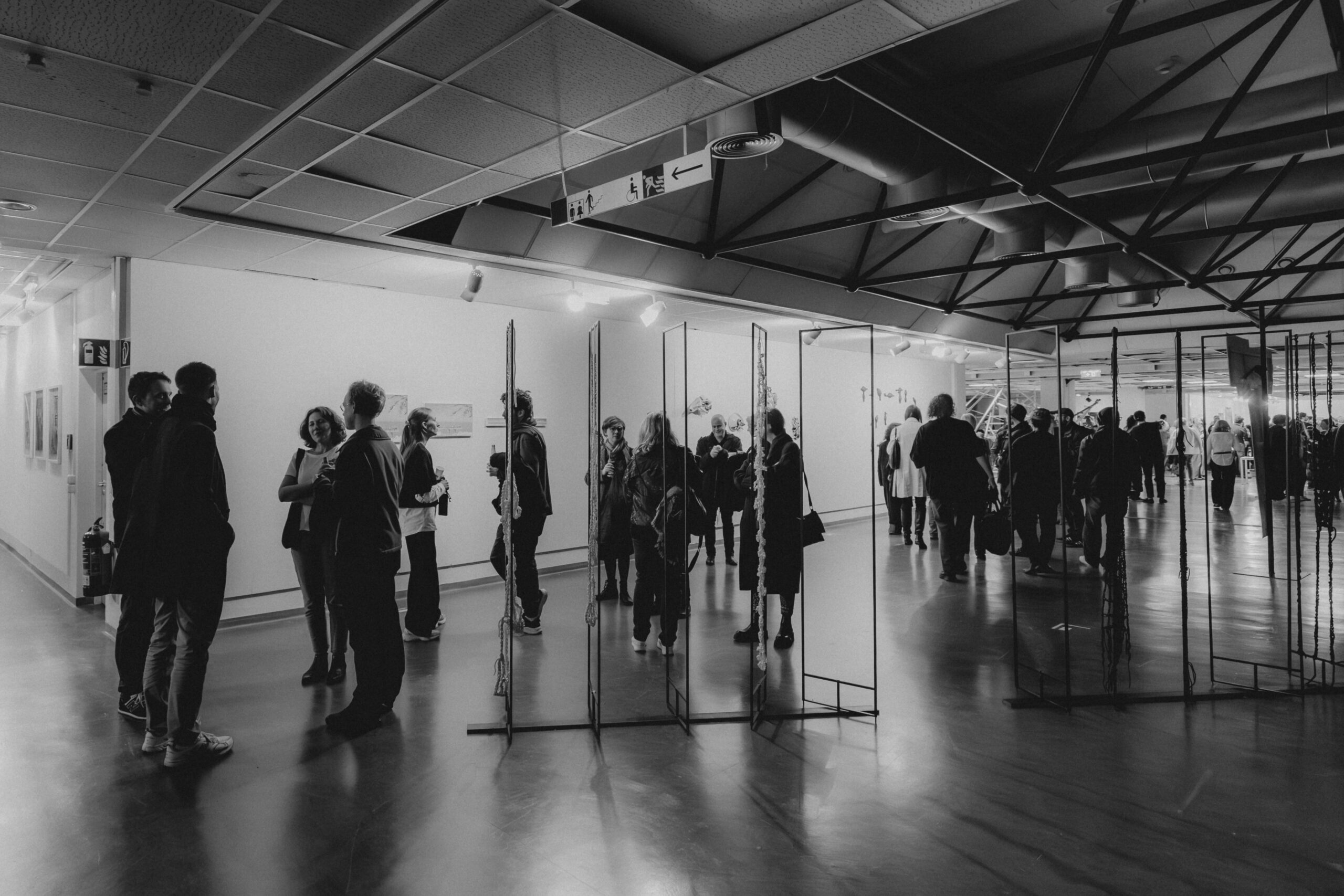
Artists [ Invited by Sebastian Pfeifhofer and Melina Steiner ]
Manuel Bachinger, Danijela Bagarić, Mina Banabak, Ziegi Boss, Tomiris Dmitrievskikh, Annika Eschmann, Jonas Fliedl, Lisa Glonti, Maria Gvardeitseva, Julia Hahnl, OU Jiun-You, June Kitho, Anthony Kroytor, Sanja Lasić, Nadine Lemke, Meike Legler, Oliver R. Meschnig, Peter Moosgaard, freakygreenfish, Sebastian Pfeifhofer, Laurie Schram, Melina Steiner, Sarah Steiner, Daniela Trinkl, Sarah Wilhelmy, Aga Zagraba, Q_plus_I
Artists [ LBI-NetMed ]
Angela Andorrer, Die Aschenbrecher, Albert-László Barabási, R. Friedrich Bliem, Katy Börner, Patryck Chan, descent, ECHTZEITKUNSTWELT, Thomas Feuerstein, Funkyfiona, Dominik Grünbühel, Begi Guggenheim, Felice Gotthardt, Christiane Hütter, Julian Jankovic, Martin Krammer, T(n)C, LBI-NetMed, Monica LoCascio, Rica Fuentes Martinez, Daniel Mazanik, Vanessa Mazanik, Ernst Miesgang, Stella Mondin, Oskerhase, Monika Pietrzak-Franger, projectvime & Te En Chen, Sebastian Pirch, Luca Ruzsics, Chris Schratt, Bettina Schülke, Clemens Stecher, STUDIO 101010, Annette Tesarek, The Meaningful Noise Collective, Norbert Unfug, Oleg Ustinov, Ana Vollwesen, Alexander Zaloopin
LBG OIS Center
Mary Maggic, Dora Siafla, Hollis Hui, Julia Guthrie, Jack Heseltine, Ines Gerard-Ursin, Lukas Troyer, Mathieu Mahve-Beydokhti, Michael Artner, Péter Velősy, Georg Russegger, Thomas Palfinger
All photos unless otherwise stated. : © Sophie Menegaldo | Ivory Rose Photography
Manuel Cyrill Bachinger
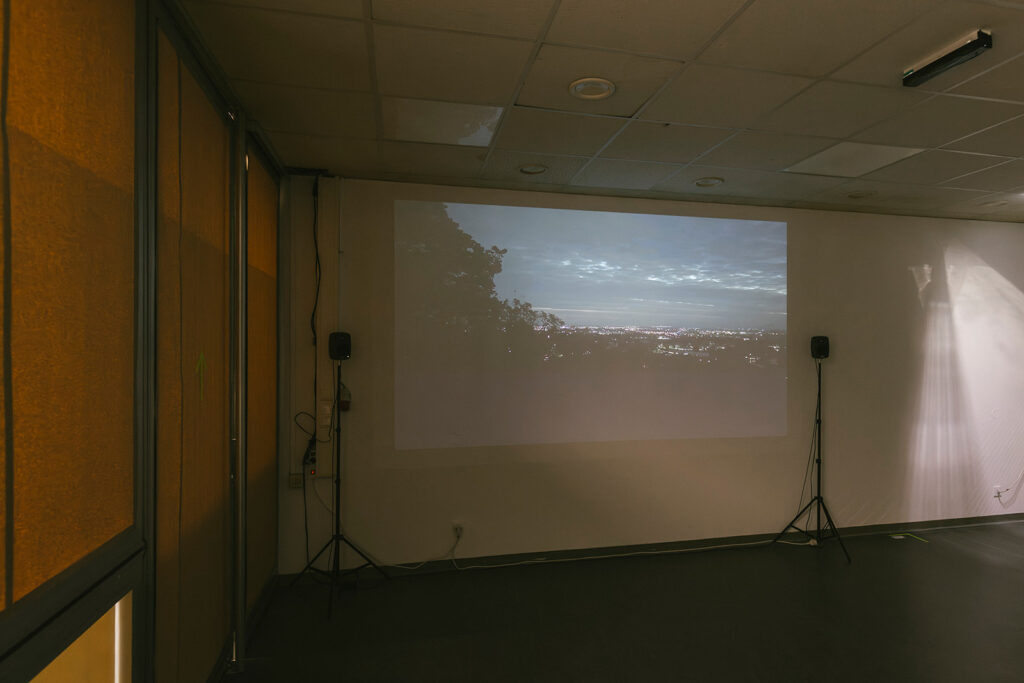
Global Shutter, 2025
@manuelcyrill / lyricallumen.com
In the work Global Shutter, the exposure time of a video is transferred onto its soundtrack, so that it can be heard for the corresponding duration of each frame. As a result, the gaps between individual frames become sensually perceptible, the illusion of continuous movement is disrupted, and the quantization of information becomes audible. The video shows the suburbs, examined in terms of their significance as a non-place, standing in contrast to the discrete, disconnected frames as a site of discontinuity, loneliness, and resemblance.
Angela Andorrer and Monica C. LoCascio
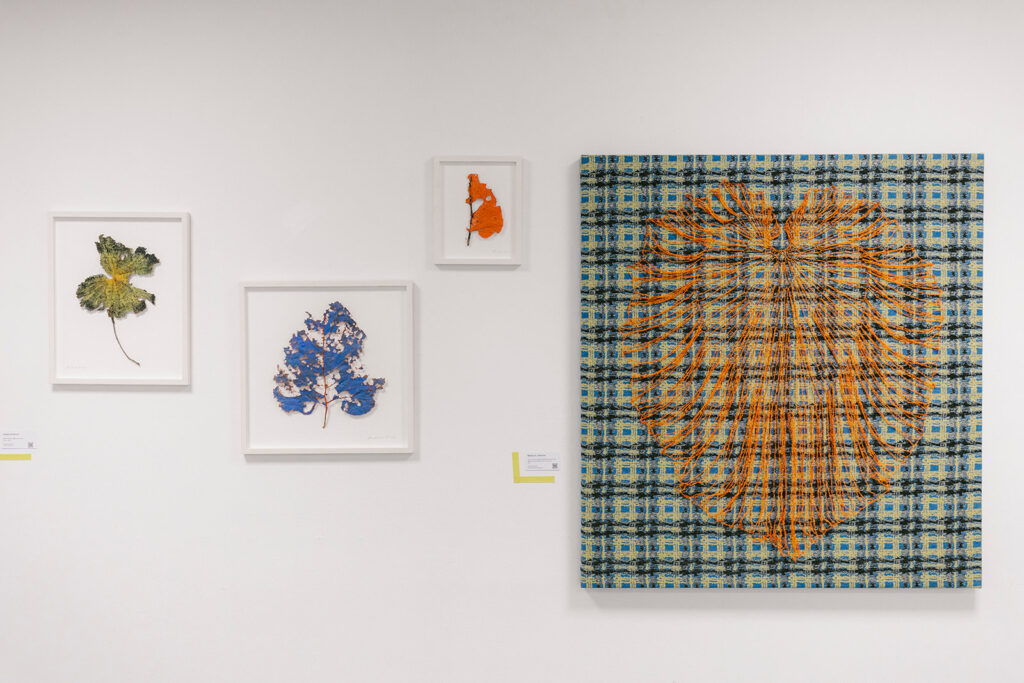
Tending Nature Year, 2025,
andorrer.at / @Angela Andorrer
monicaclocascio.com / @Monica C. LCascio
Tending Nature presents textile and nature-based works by both artists, exploring their relationship with organisms and questioning what environmental care means. Andorrer repairs and supplements tree leaves with paint, yarn, and bead embroidery; LoCascio’s organic sculptures were created from cords, yarns, and textiles during her pregnancy and the first weeks of motherhood. Both pay tribute to organisms as ecological actors: for Andorrer, vitally essential through oxygen production, for LoCasio, as an examination of the role of genetics in societal roles. They invite a rethinking of the boundaries between human, plant, and epigenetics, and an acknowledgment of symbiosis as the foundation of our environment.
Danijela Bagaric
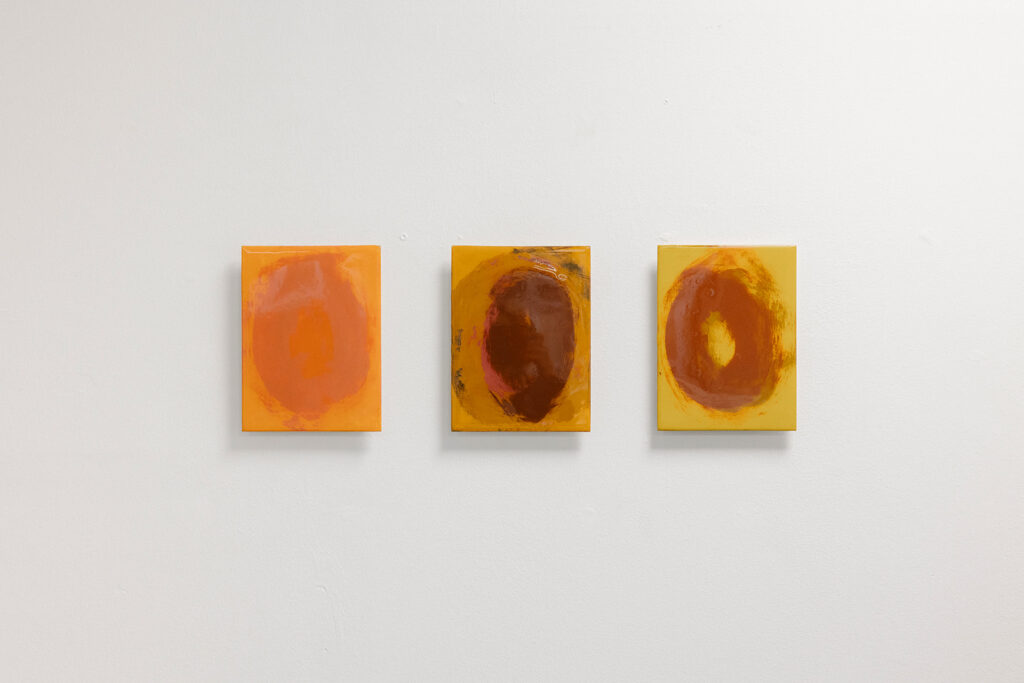
Im Schweigen tanzt das Unausgesprochene, 2025
„Im Schweigen tanzt das Unausgesprochene“ is a series of gestural color compositions in which form and movement act as a silent language. Without narrative intent, without figures, a space is created in which the invisible is hinted at—an intermediate realm between intuition and presence.
My work does not seek to depict, but rather to capture the inner echo of a gesture, the pulse of color, the reverberation of movement. The images are condensed states—traces of the body, resonances of the moment.
Each circle, each surface, each gradient is a fragment of the unspoken that comes to life in silence.
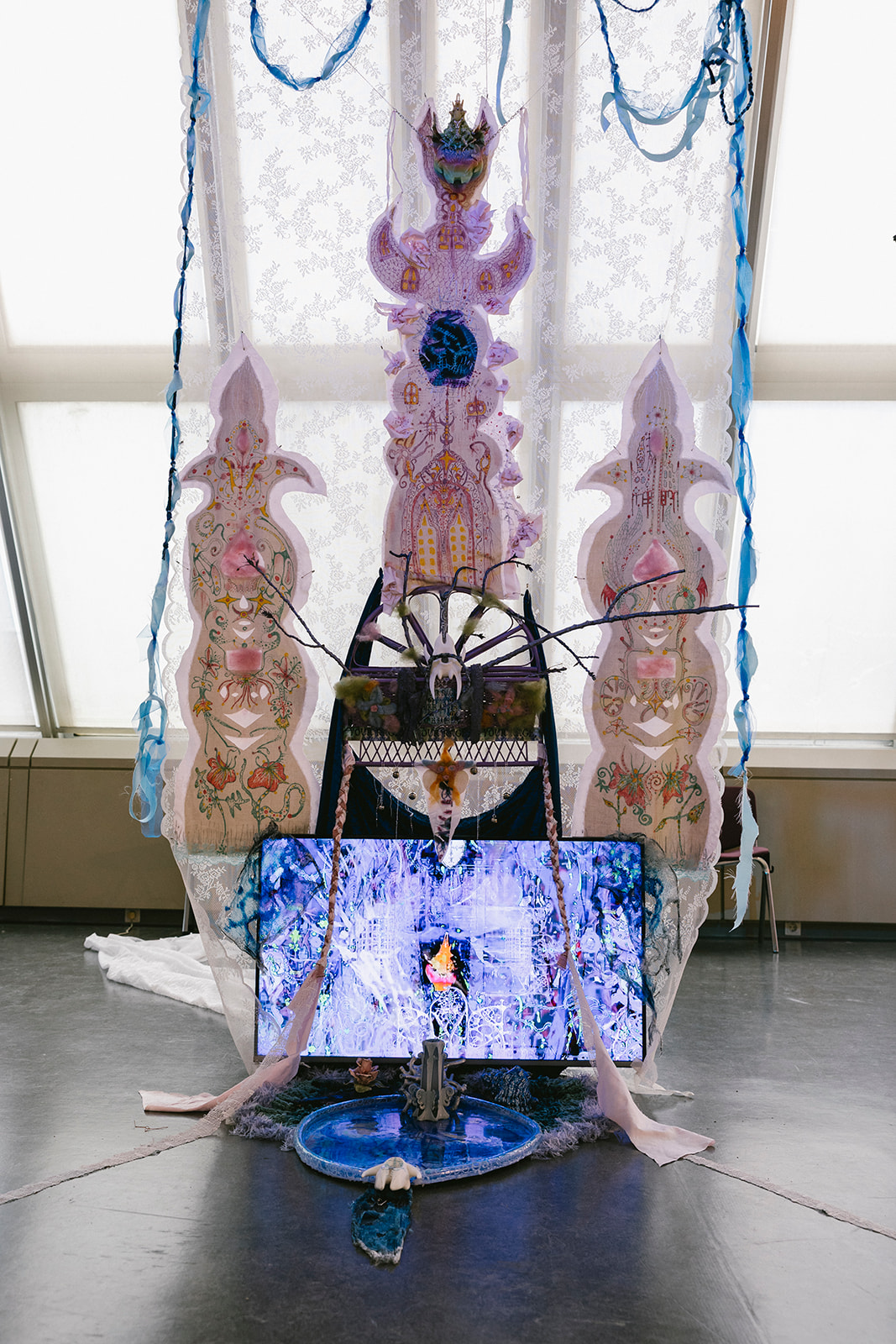
Die Aschenbrecher
Symbiotechniose, 2025
Die Aschenbrecher is a mixed media nymph. For this space they compose a post-digital temple, frames are arising in diverse forms to honour the birth of a new symbiosis. Textile drawings, treasures from nature, 3D printed creatures and flickering screens form windows into a realm of radical empathy.
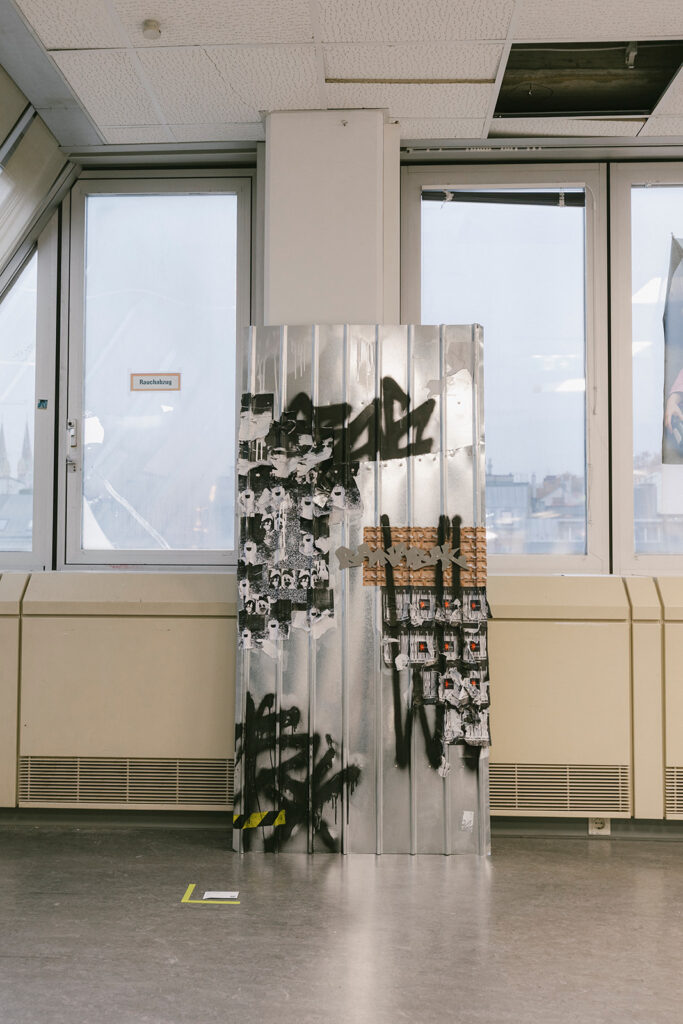
Mina Banabak
dikkat!, 2025
dikkat! Is a 90*195cm corrugated metal object, part of a two piece series inspired by the architectural and visual urban landscape of Istanbul. Corrugated metal, often used in construction and barriers, has become both a physical and symbolic surface in the city. It is a material that tells stories of expansion, change, and transience and also serves as a canvas for countless layers of urban expression.
In my perception the city acts as the frame, its walls are the canvas and the ways people mark, alter or intervene in them completes the artwork. Stickers, posters, flyers, and tags, often small and repetitive, are what shape the visual identity of a place. They become signifiers of the people who live there, reflecting cultures, politics, desires, power structures and teenage slang. In their accumulation they create an unofficial archive of urban life.
By working with corrugated metal I directly engage with the surface that exists everywhere in the city, yet usually goes unnoticed. It is both industrial and fragile such as temporary and permanent. On this surface I build collaged layers that are reminiscent of the textures found in urban spaces, where no single hand defines the outcome but rather a collective process of constant change.
dikkat! reflects on the blurred boundaries between frame, canvas and artwork.
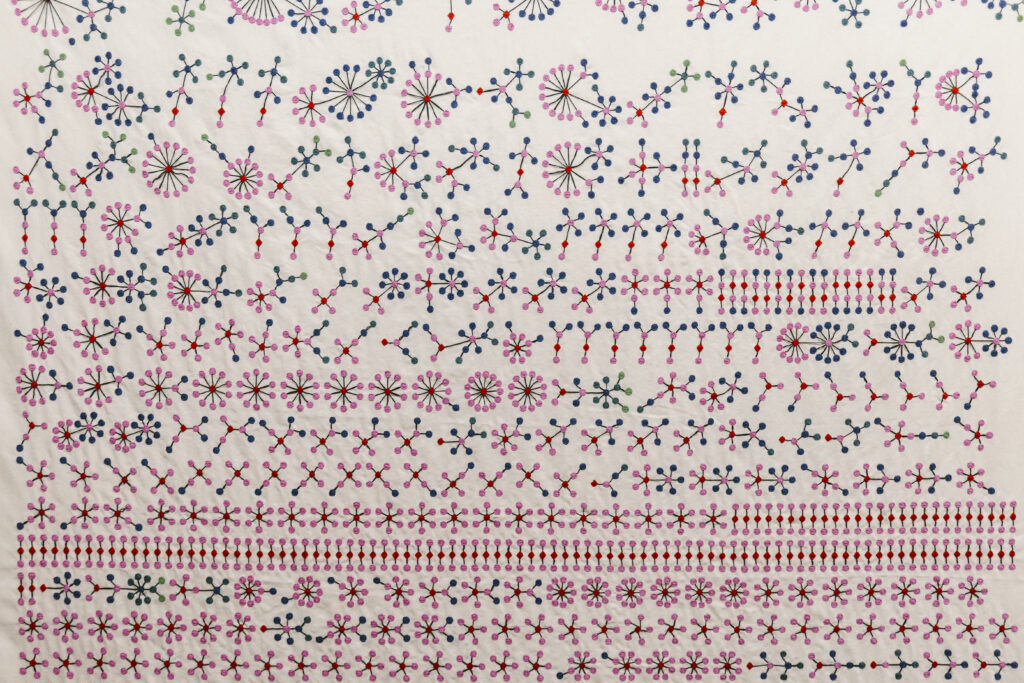
Albert-László Barabási (BarabásiLab)
Social Network Response to Crisis (ETA Bombing), 2007–2009
BarabasiLab.com / networksciencebook.com / @barabasi
Between January 2007 and January 2009, the BarabásiLab used mobile phone data to detect human reactions to a whole slew of life-threatening events, from bomb explosions to riots.
ETA detonated a car bomb in a parking lot of the University of Navarra just south of Pamplona on October 30, 2008 at 11:00.
Combining national mobile-phone records to identify the individuals who experienced the event and analyze their reactions, in the form of whom those individuals called and when they made calls. The links of the networks capture calls that the witnesses, shown as red squares, made immediately following the event and the subsequent calls their acquaintances, shown as circles, made upon hearing the news. Colors capture time—the blue nodes represent individuals to whom the news arrives later as they are at the end of the chain of calls. These visualizations describe how the sensitive fabric of the social network springs into action in the face of an emergency through a series of events that flare up like independent forest fires. They also show that while most news will dead-end in small pockets of the social network, a very few witnesses will create global awareness by triggering the engagement of hundreds of individuals.
Artarchive link: https://www.artworkarchive.com/pieces/emergencies-pamplona-trypticon
Ziegi Boss
Our Civilization Depends on You, 2025
Our Civilization Depends on You examines the endless parade of instructions women are told to follow: have children, embrace your “feminine essence,” align with the moon, please civilization, please God, please anyone. These directives have echoed for generations — through religion, family, and culture — but technology has amplified those quiet whispers into a constant hum, rebranding belief as lifestyle and ideology as aesthetics.
Drawing on pronatalist messaging, womb-spirituality influencers and Tradwife aesthetics that echo religious doctrines of submission, the work explores how ideology circulates like white noise: compelling, manipulative, and impossible to tune out.
At its center is the artist’s sterilization: a preserved fallopian tube and lab report as an act of embodied refusal. Around it, AI-generated voices echo persuasive scripts — smooth, unfeeling, relentless. They mirror the machinery of online influence itself: systems that automate conviction, amplify obedience, and package ideology for mass consumption.
The work stages a collision between autonomy and system, body and ideology. The preserved specimen becomes a monument to everything that will not happen — a lineage ended, a script torn up, a civilization that will have to depend on someone else.
R. Friedrich Bliem
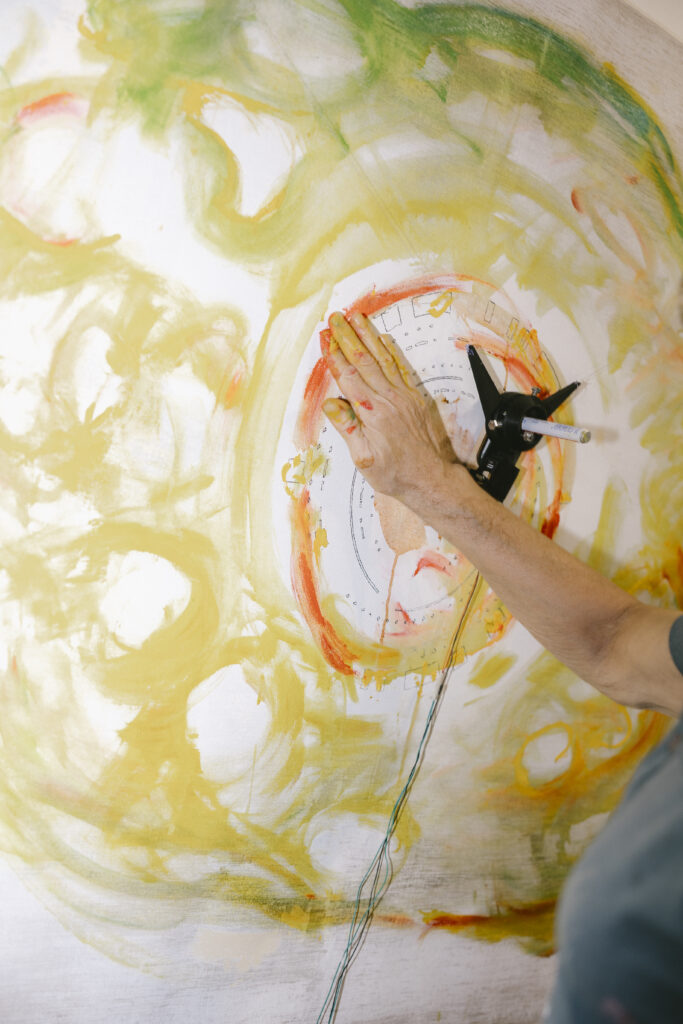
Painting: Cells, Tissues and Organs – whole system view, 2024/2025
Conceptual Statement: R. Friedrich Bliem’s practice is situated at the intersection of scientific inquiry and artistic expression. His work investigates the intricate patterns of the biological microcosm, translating these invisible systems into vivid, aesthetically tangible experiences. Bliem’s methodology allows viewers to engage with the complex, underlying order where scientific principles and artistic interpretation resonate.
For this exhibition, Bliem expands his generative process by collaborating directly with a drawing robot. This specific work, Painting: Cells, Tissues and Organs – whole system view, explores the emergent dialogue between human creative intuition and programmed machine precision, questioning the boundaries of authorship and representation in a technologically mediated world.
Tomiris Dmitrievskikh
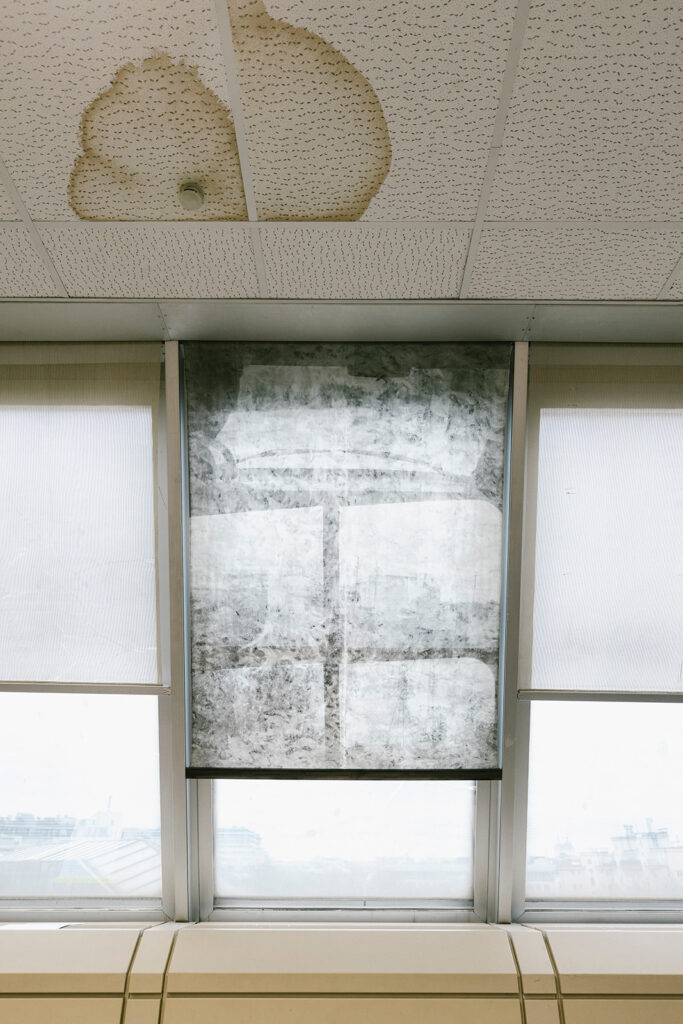
Window view, 2025
This work is part of an ongoing artistic research project focusing on industrialized territories in Western Siberia, Russia. The images were captured during a journey through areas where access is often limited or controlled by permits due to oil extraction activities. All photos were taken from the window of a car. The window acts as a literal and metaphorical frame, defining what is visible and shaping perception while highlighting the tension between movement, control, and fleeting observation.
Katy Börner
Atlas of Macroscopes: Interactive Data, Visualizations, 2025
scimaps.org / luddy.indiana.edu/contact/profile
The Atlas of Macroscopes showcases 40 real-life macroscopes, or interactive data visualizations, that were displayed in the “Places & Spaces: Mapping Science” exhibit (2015–2024). Encompassing vast amounts of data, macroscopes provide holistic views of complex systems or networks. They provide an entry point for scientists and laypeople alike, and empower them to engage directly with large datasets and to conduct their own lines of questioning. As interactive tools, macroscopes connect data creators and users. As portals to continuously evolving data, macroscopes can serve as windows to the dynamics of any terrain—personal or professional, local or global—and offer key insights into our surroundings. They transcend the static nature of traditional maps, helping us see the big picture as we seek to better navigate our ever-changing world.
Annika Eschmann
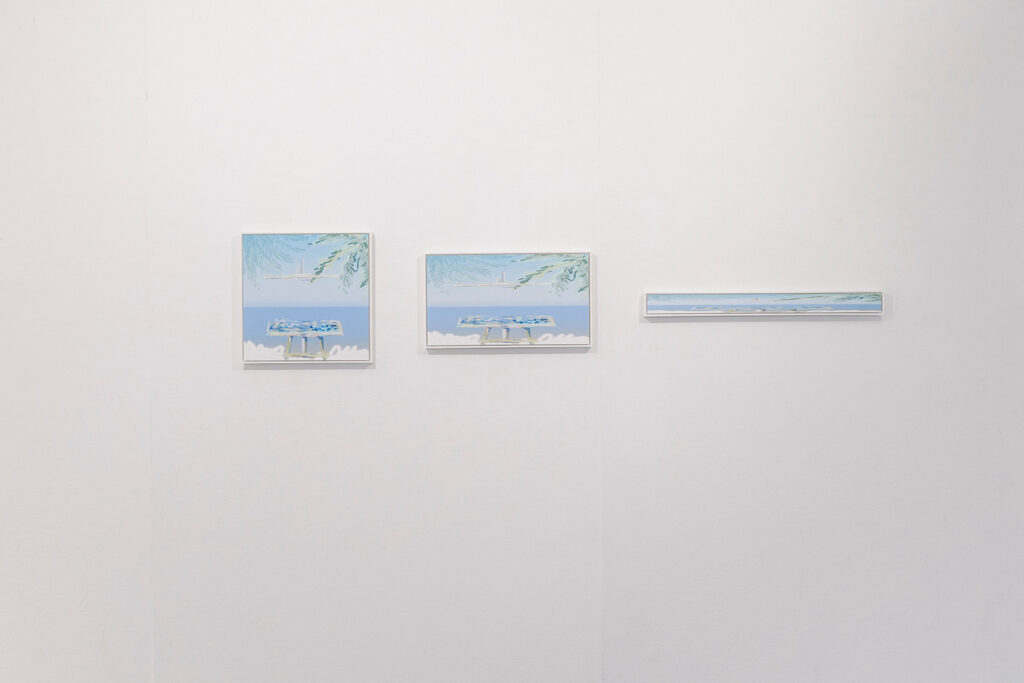
Artist´s Paradise, 2023
@annika.eschmann / annikaeschmann.com
The work plays ironically with the flexibility of economic values and the associated ideas of paradise, using the formula (Height + Width) × Factor = Price.
This formula is used to determine the price of artworks and largely ignores the actual production costs. It leads to the paradoxical situation that the more elongated a picture is, the more expensive it becomes.
The reason for using a formula that describes the outline of an image in relation to the factor, rather than one that describes the surface area, might be that traditionally the cost of a frame was calculated according to the total length of the frame strips needed: Height + Width = Price.
Patryck Chan
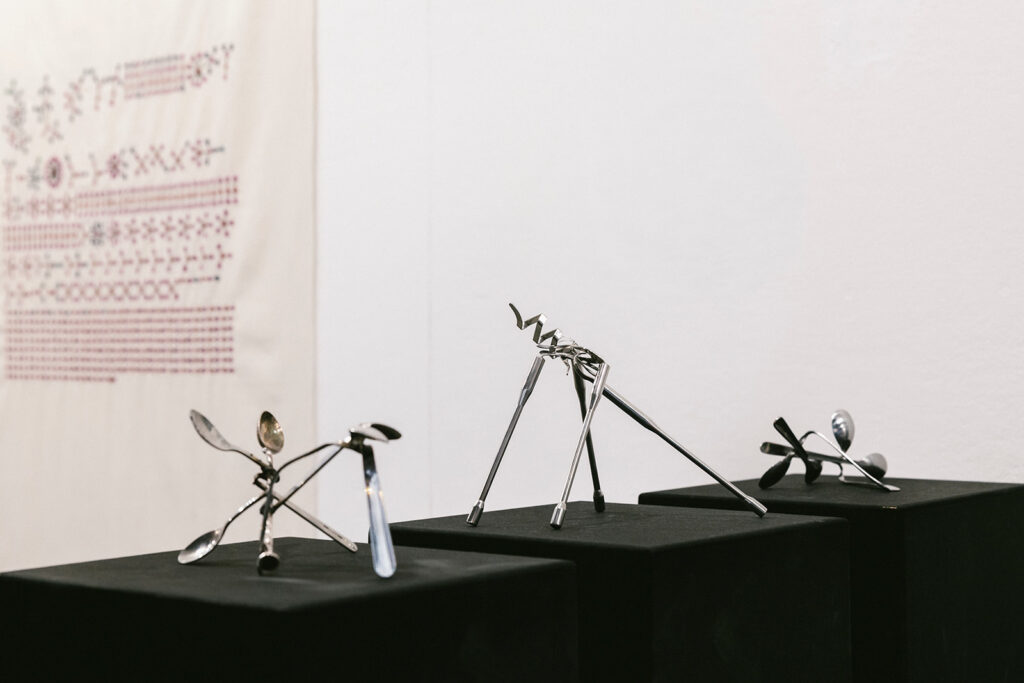
Spoons Unite, 2025
www.patrickchan.org / @patryck_chan
Patryck Chan is a Multi-cultured, Multi-gifted, Multimedia Artist. He presents “Spoons Unite” miniature sculptures, unique photographs, and overpainted originals of the objects. This idea/concept was brought forth as a Hommage and Demontage from VALIE EXPORT’s work “Scissors Dancers”
Jonas Fliedl
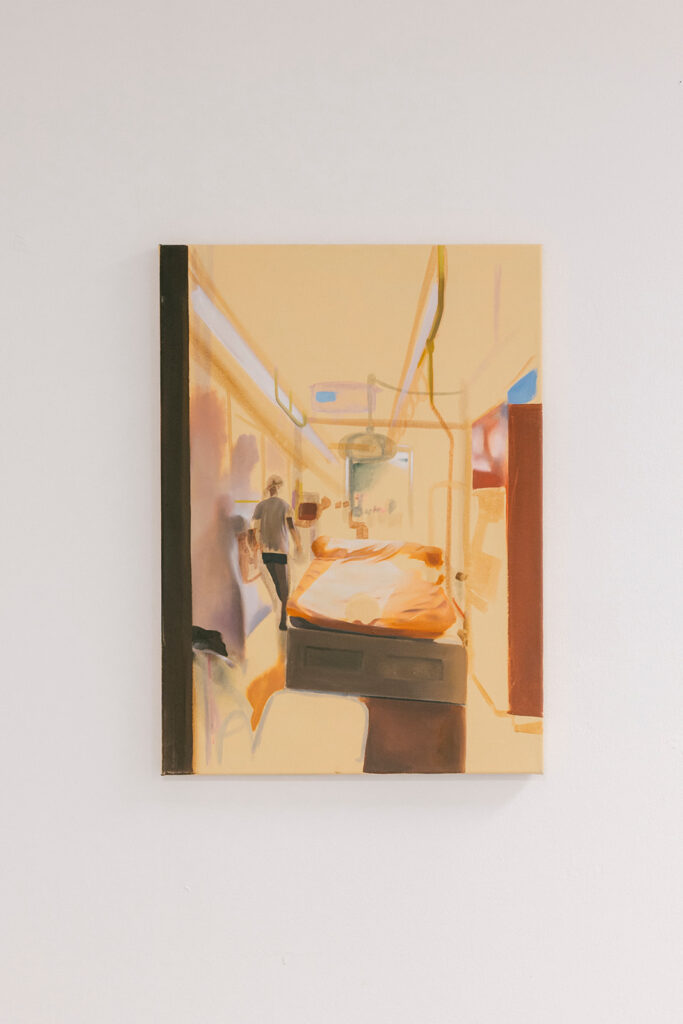
Bimbett, 2024
The work shows an intimate moment that enters into a dialogue with scenes from the public, urban space. Contrasts such as dream and reality, the visible and the invisible, the private and the public, as well as abstraction and figuration, play a central role.
Thomas Feuerstein
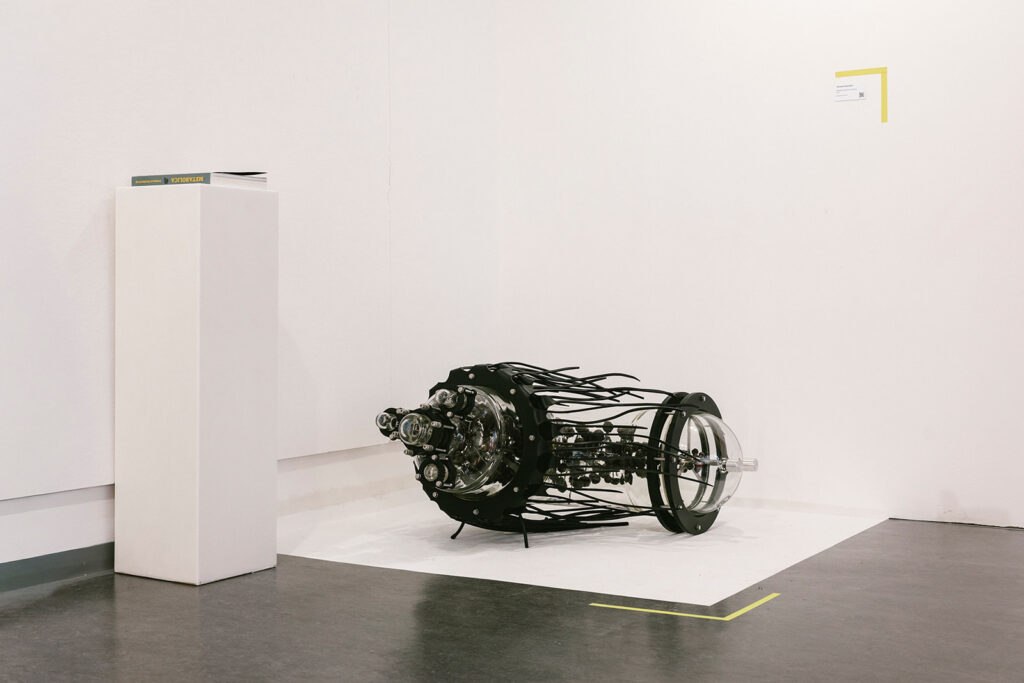
MAGGOT , 2024
“MAGGOT” is part of Thomas Feuerstein’s broader “METABOLICA” series, which functions as “metabolic art” by using living organisms as active collaborators in the creative process. Philosophically, the work explores the full cycle of life and transformation, as the sculpture’s key material (the bioplastic PHB) is produced by bacteria that metabolize algae. In this system, the bacteria act as both the “quarry” by creating the material and the “chisel” by having the potential to degrade it, thus questioning the boundaries between natural processes and artificial creation.
Lisa Glonti
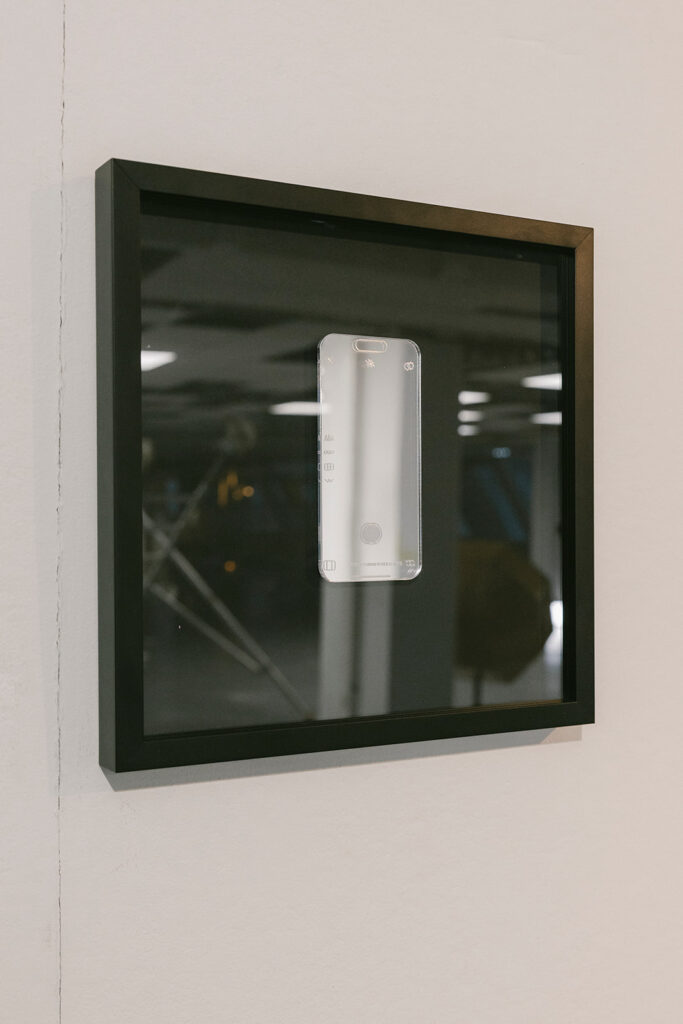
Selfie Mirror, 2025
@Lisaglonti / www.lisaglonti.com
Social media users constantly frame themselves within its interfaces. Through the frame of the ‘story’ camera, they curate their auto-portraits, selecting what is seen and staging their identity.
‘Selfie Mirror’ is a translation of this digital gesture into a static sculptural object. Visitors become the subject. They encounter their own reflection inside a familiar interface. The observation of the artwork is the observation of self-framing.
A smartphone-shaped elevated mirror is mounted on a 30 × 30 cm black surface and enclosed in a black frame. The mirror has an engraved outline of the ‘story’ camera interface. The mirror consists of three frames: the physical frame of the object, the digital frame of the interface, and the perceptual frame of self-image.
ECHTZEITKUNSTWELT (Dominik Grünbühel, Sebastian Pirch, Norbert Unfug)
THE DRONE, 2025
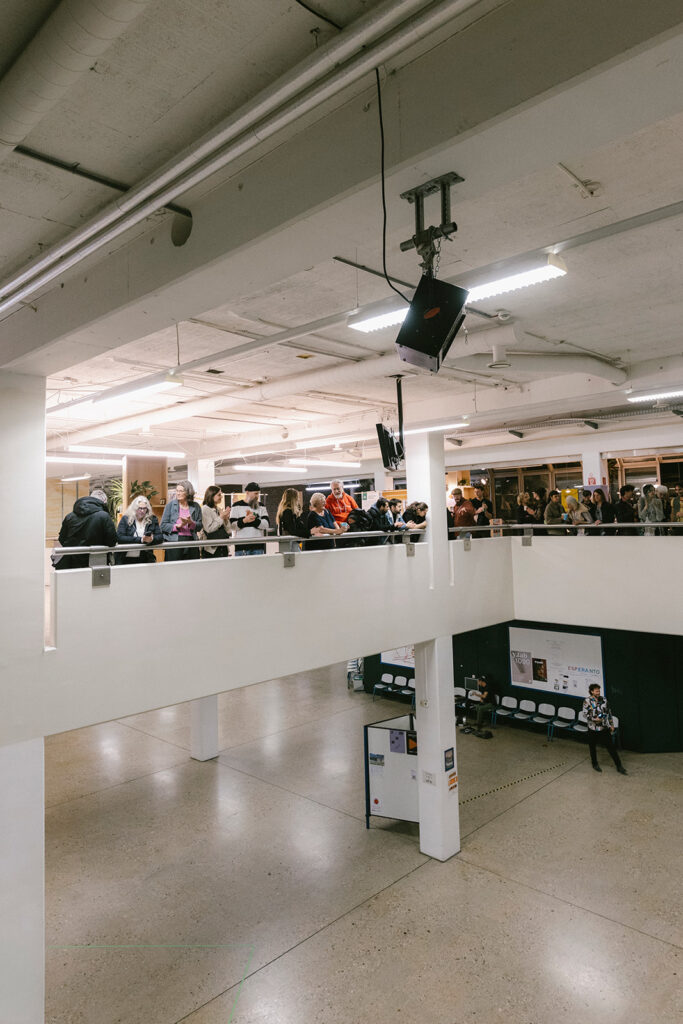
Echtzeitkunstwelt is an online, multiplayer framework in VR (virtual reality). For “THE DRONE,” the collective conducts drone flying experiments, integrating them into their digital environment. In the interplay of various art forms (puppet theater, music, dance, visual arts…), the artists explore the possibilities of performance and liveness in digital space—always adapted to the specific site. Visitors can influence the process interactively, individually, or collectively, making the experience a physical one. The online multiplayer function allows people from all over the world to participate.
Maria Gvardeitseva
Men in Suits, 2024
@maria.gvard / mariagvardeitseva.com
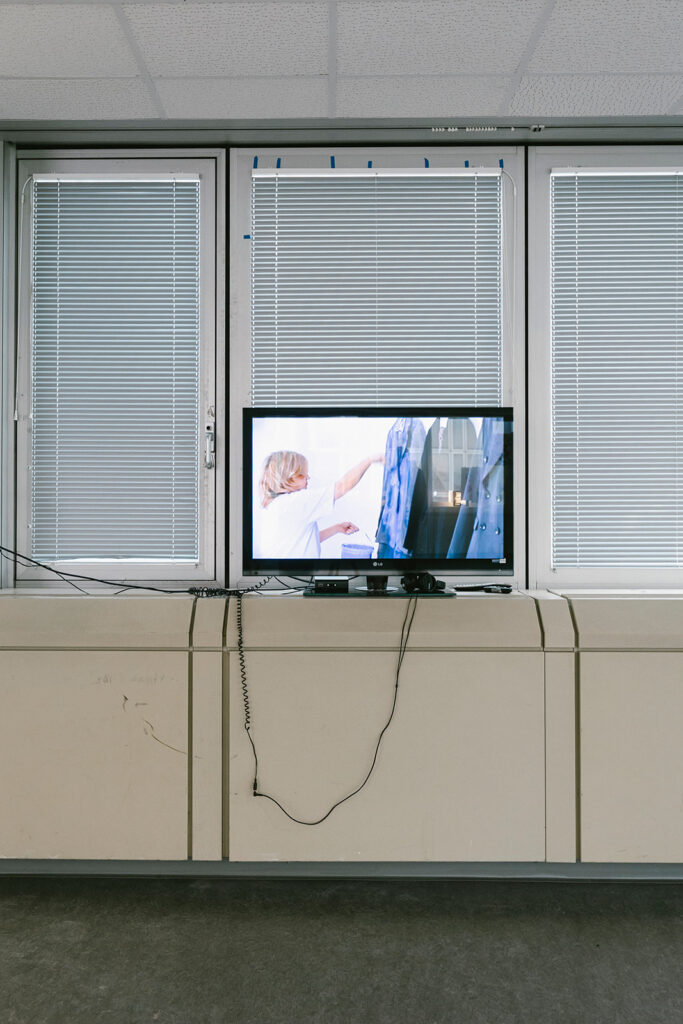
Men in Suits by Maria Gvardeitseva is a video performance that explores how systems of patriarchal power are represented and remembered. Inspired by Yves Klein’s Anthropometries, the work replaces the absent male artist with the active presence of a woman, positioning the artist as both participant and witness in the act of creation.
In the performance, men’s suits, longstanding symbols of authority, are soaked in a bright pigment Gvardeitseva calls International Misogynistic Blue. The garments are then dropped, stepped on, and pressed onto paper, leaving behind fragile “memory-prints.” These impressions capture a system in decline: they record its collapse while also suggesting new possibilities. What remains is both a document of what is fading and a hint of what may emerge.
Through this process, Men in Suits questions who controls cultural narratives and who has the power to reshape them. In the in-between space of the “blue hour,” the work imagines rhythms and frameworks that move beyond rigidity.
Ultimately, the installation reframes the visible and the invisible. It turns attention to inherited structures of power, while the acts of marking, erasing, and repeating become tools for witnessing transition and imagining a more open, inclusive future.
Funkyfiona
Meraki , 2025
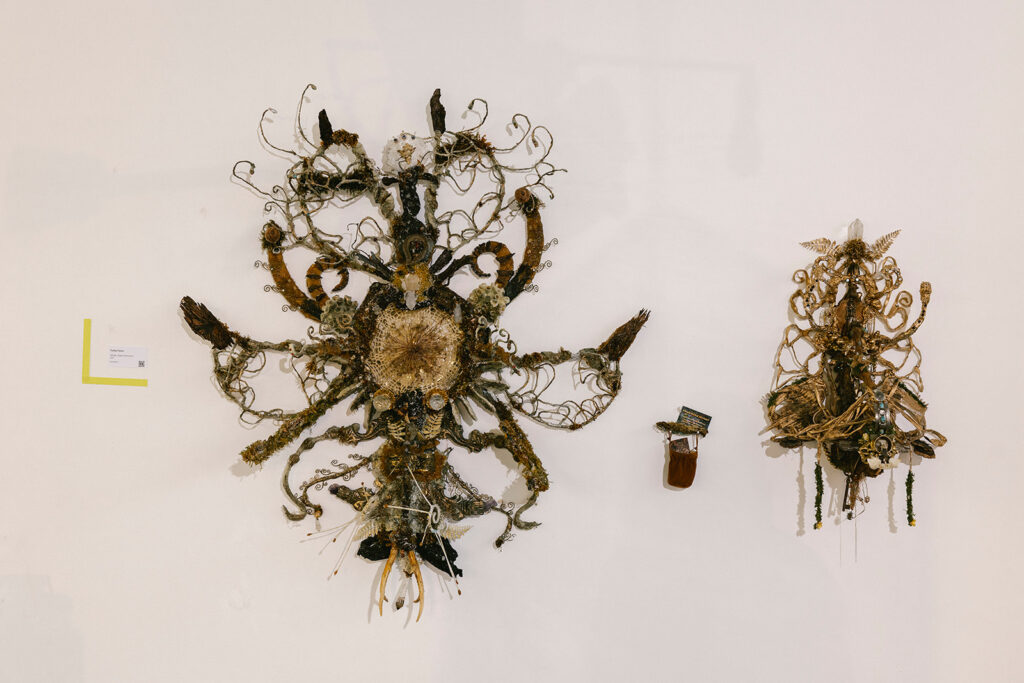
I am fascinated by pure existence – the incomprehensible miracle that everything exists. The countless details, the delicate structures and connections that reveal themselves in every moment, in every form, in every breath. This perception that everything is interconnected fills me with a deep curiosity and boundless energy. My art arises from this fascination. It is an attempt to make wonder visible – about life, being, passing away, and re-emergence. In my works, natural materials, found objects, and textile elements interweave into organic structures that appear both familiar and strange. I want to create spaces that invite pause – where one senses that everything is alive, changing, and in relationship to one another. My works are an expression of mindfulness, of connection, and of the inexhaustible inspiration that mere existence carries within itself.
Julia Hahnl
Archives are cold, 2024
Archives are Cold explores the fragility of digital media archives by focusing on their thermal dependencies. Inspired by Nicole Starosielski’s Media Hot & Cold and its notion of “thermocultures,” the work rethinks data centers not as secure repositories but as infrastructures where cooling systems and environmental controls dictate whether data survives or disappears.
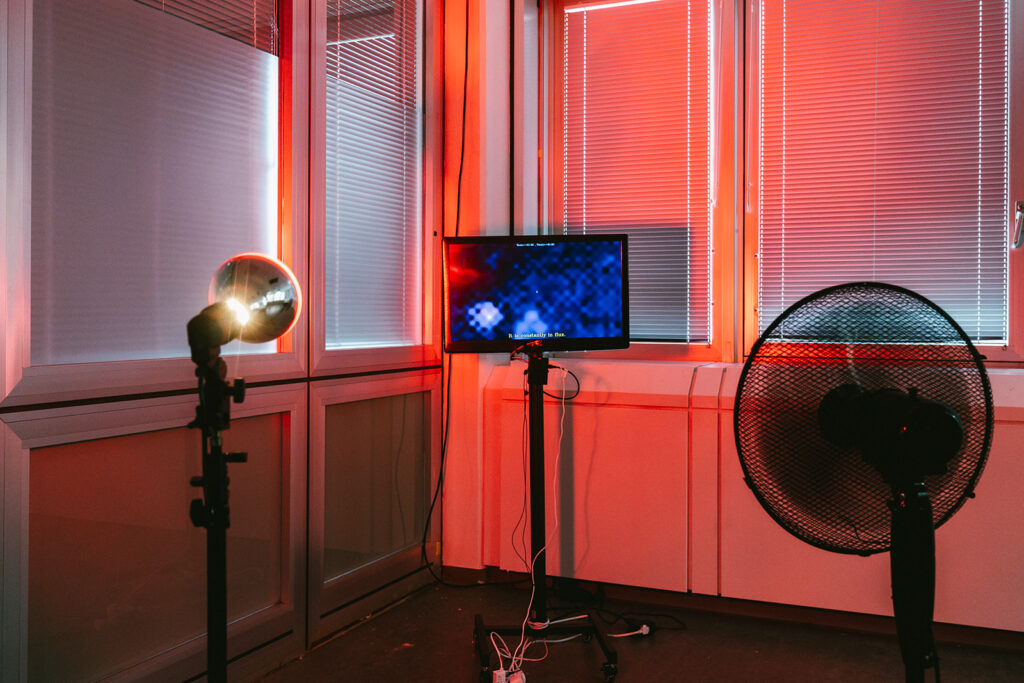
The installation presents a live thermal camera feed layered with subtitles. The thermal spectrum becomes both a visual and conceptual frame, revealing what usually remains outside public perception: the infrastructural and environmental conditions that sustain our digital memory.
A heat lamp and ventilator, programmed through microcontrollers, intervene in the exhibition space by altering temperature in real time, making viewers physically aware of these hidden dependencies. By translating the politics of preservation into sensory experience, Archives are Cold exposes how digital archives are governed by corporate interests, political agendas, and material limitations. In doing so, the work highlights the vulnerability of supposedly permanent digital landscapes, reminding us that collective memory is always precarious and conditioned by power, technology, and environment.
Begi Guggenheim
Drone, 2025
artcoas.com/kuenstler/begi_guggenheim / @begiguggenheim
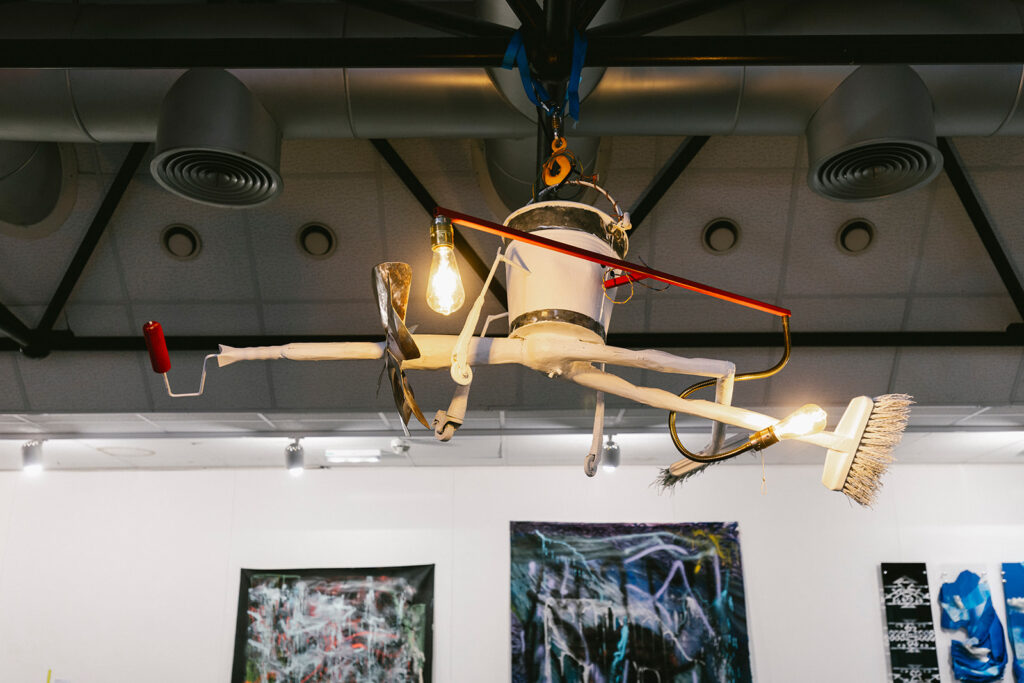
The sculptor´s work is characterized by a distinctive morphology. Technologically modern approaches meet extremely contemporary aspects. His figures are oftten reminiscent of cyborgs. Trashy elements meet precise elaboration. Objects trouvés often are the formative elements of his sophisticated compositions.
OU
The Atlas V – 139, 2025
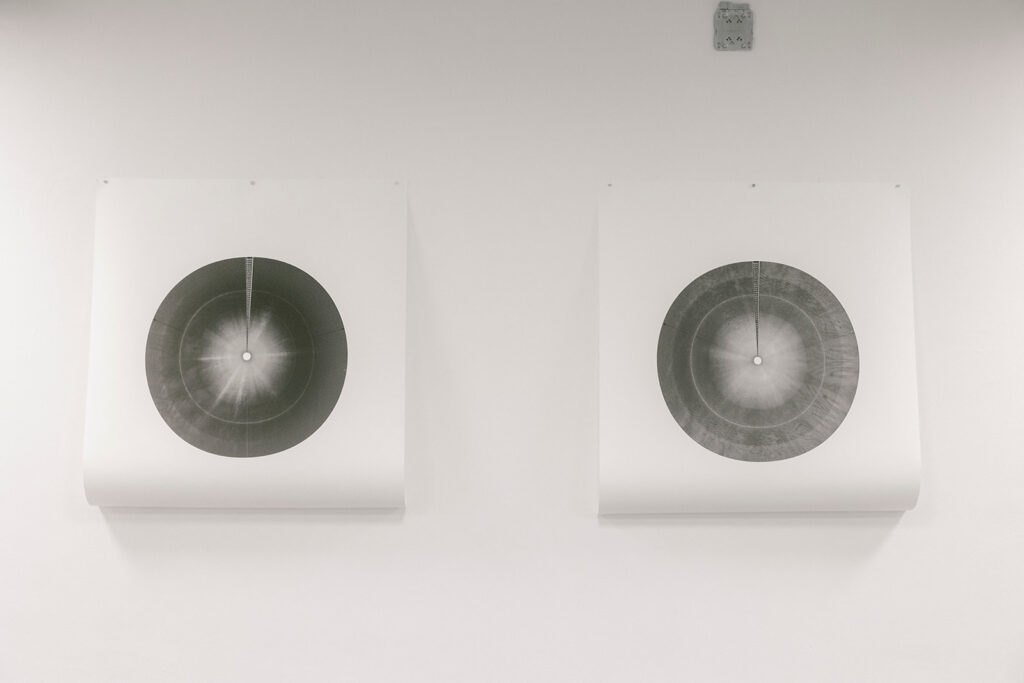
As part of her ongoing Atlas series, OU Jiun-You selects several locations she frequents within the building to create a personal map of Funkhaus. Directional sound ephemerally penetrates the space, reaching beyond what the naked eye can perceive. The recorded and processed soundscapes reflect the building’s architectural geometry, spatial materiality, and its various happenings, metaphorically connecting individuals to the site as resonant frequencies form a sensory bridge to its history. Prints were kindly supported by Never at Home.
Felice Gotthardt
school of sight, 2025
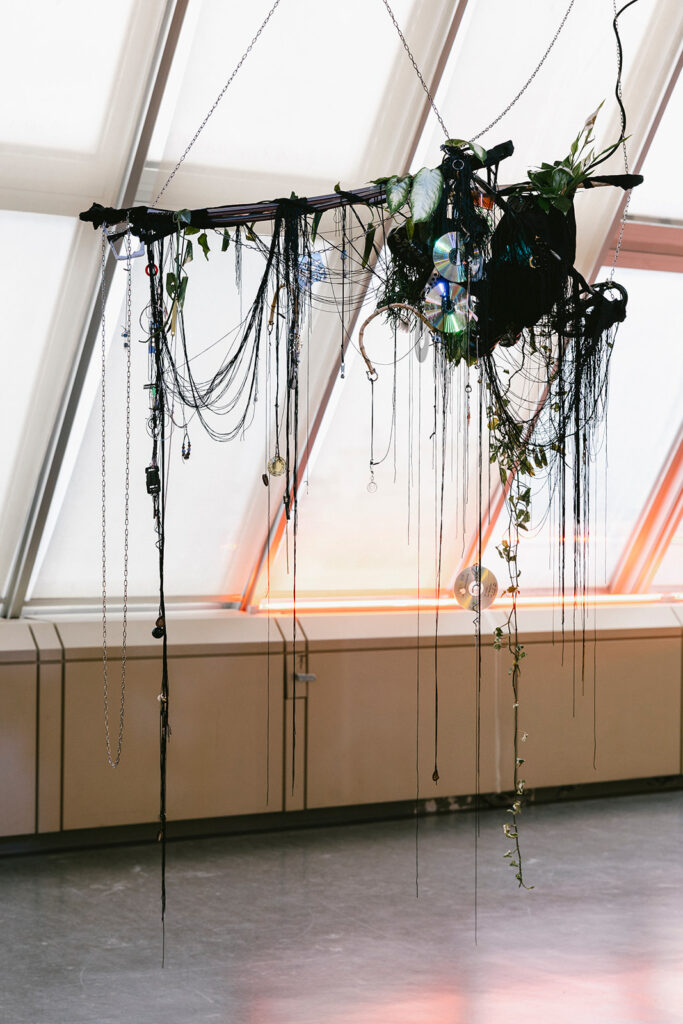
The focus of my installation lies on training one’s gaze by altering perspective and learning to view objects differently. What additional value can we assign to them, beyond the context in which they seem to exist or the purpose for which they were created? By revealing beauty in what appears to be coincidence, the installation simultaneously teaches us to change the way we look – and how we begin to think further.
June Kitho
entangled II, 2025
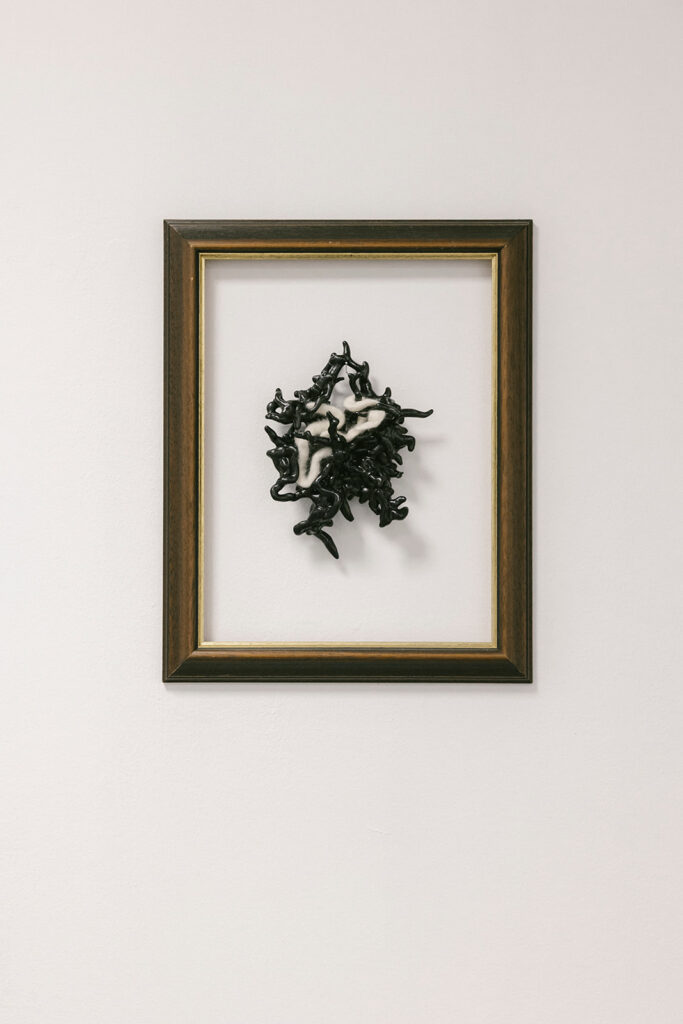
“entangled” explores how systems are interconnected and whether new things can emerge from old structures. A change in one area can influence the entire system, even if it occurs slowly and imperceptibly at first. It reflects how everything is connected and how small actions can lead to larger changes.
The wooden frame originally belonged to my grandfather and once held one of his stone mosaics – works that fascinated me as a child. Although the frame now draws the viewer’s attention to a recent piece of my own, it also establishes a quiet link to my past – my grandmother, who gave me the frame. The frame becomes more than just a border for the image – it is a vessel of memory, anchoring the work in both history and emotion.
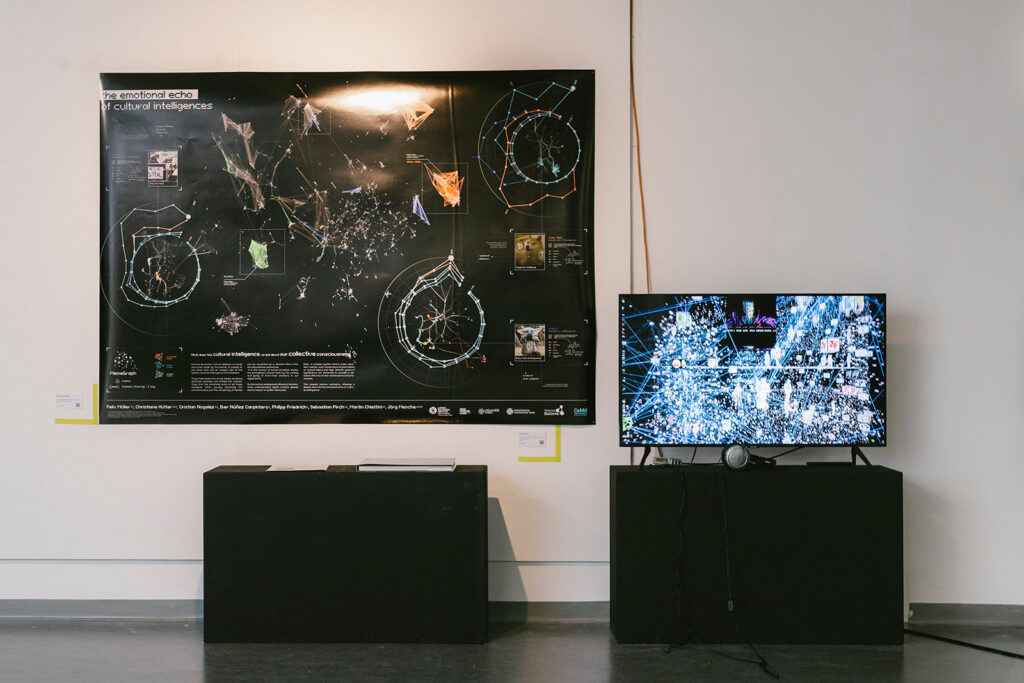
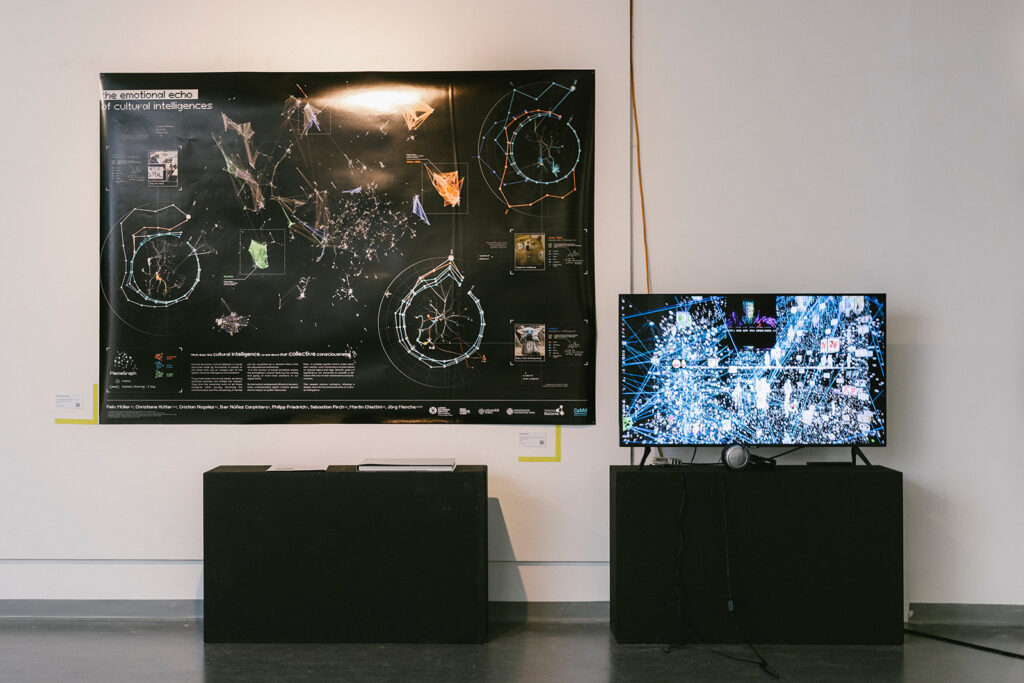
Felix Müller, Christiane Hütter, Cristian Nogales, Iker Nunez, Philipp Friedrich, Sebastian Pirch, Martin Chiettini, Jörg Menche
Echo of Emotional Intelligence, 2025
Political decisions, cultural debates, or social discourse made by thousands of people at the same time, are an integral part of the digital collective intelligence of humankind.
They trickle down into social media, are being distorted, extorted, and shifted into memes. They form the emotional echo of all these dialogues within society, becoming the communicative soil.The cacophony of memes can be visualized as a network where links encode pairwise similarities. It is the murmur of social excitation waves, the atmospheric sound made by the coming and going of short-lived emotions in our digital world.
Social media’s widespread influence necessitates understanding digital content spread and its impact on public discourse.
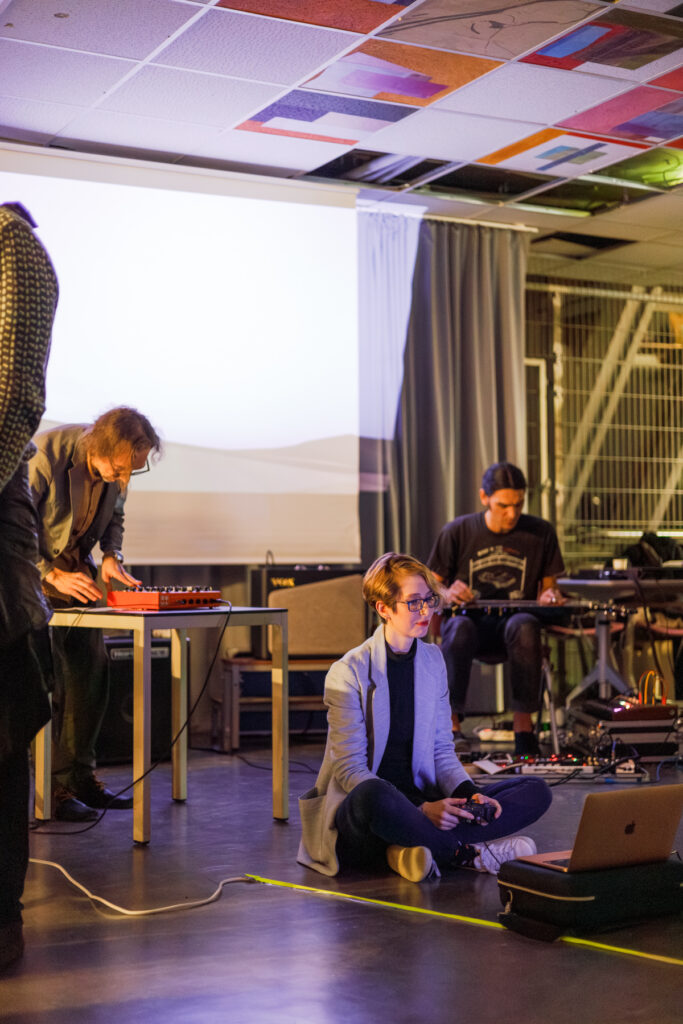
Anthony Kroytor & jeremy r.r.
Hinterland, 2025
anthonyk.xyz / jeremyrr.bandcamp.com
What is it?
A corollary to this question, felt but likely never verbalized: Since I don’t know what it is, I don’t know what to do–can I enjoy it? am I meant to take it seriously? This train of thought may easily be sidestepped with the question: What does it mean?
Hinterland definitely has music. It sounds like post-apocalyptic country music. Hinterland seems like a performance. It involves a video game–or something like it.
You are free to frame Hinterland however you like.
Photo: © Hannah Mayr
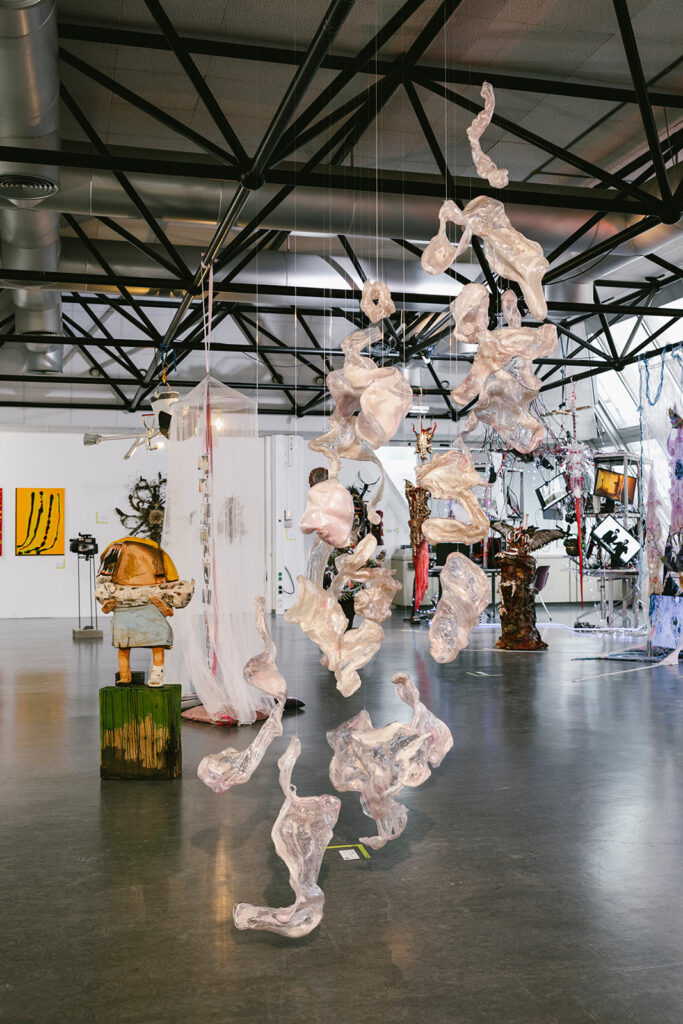
Julian Jankovic
Suspended Memories, 2025
Suspended Memories explores the fragile balance between childhood memory and emotional depth. Amorphous sculptures hang from the ceiling gently moving in response to air and light, evoking the instability of memory and perception. The installation invites viewers to physically experience a state of suspension between closeness and distance, lightness and weight.
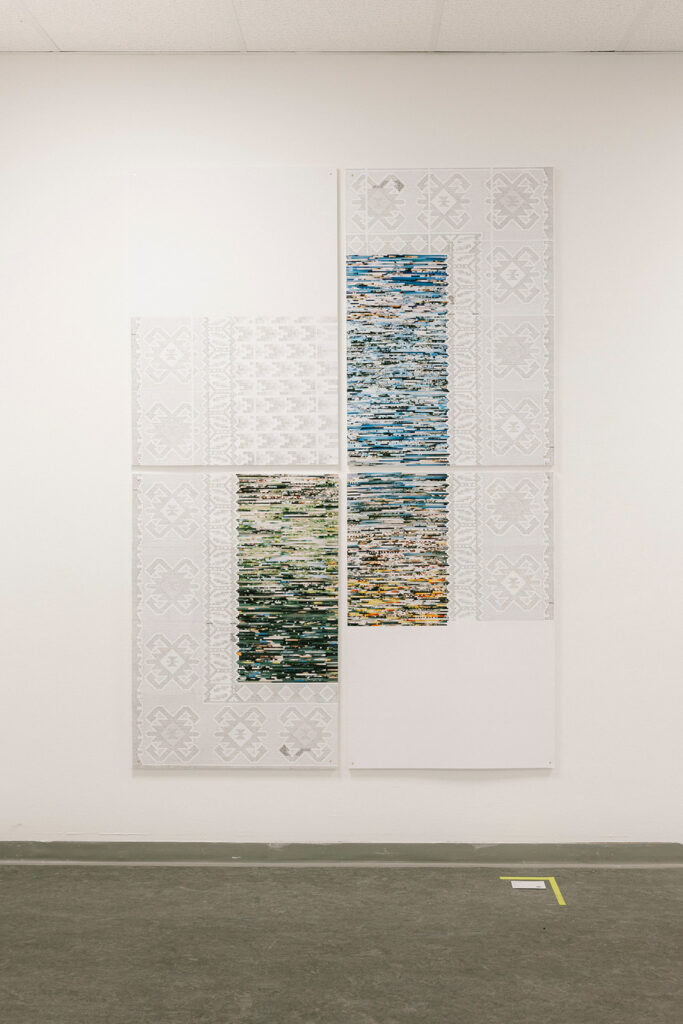
Sanja Lasić
The Turtle, 2025
“The Turtle” is a collage that merges drawing and analog photography, reimagining the tradition of Bosnian tapestry (ćilim) and its profound cultural symbolism. Drawing from the artisanal heritage of weaving, the artist translates its patterns and geometrical motifs into a personal language of belonging, memory, and identity. Through re-drawing and recomposing, she transforms the inherited visual language of the tapestry into a deeply intimate narrative shaped by her experience of forced displacement in the early 1990s from her place of origin in Sarajevo and her upbringing in Western Europe.
At the heart of the work lies a mosaic of analog photographs—an archive of fragmented memories. Cut into fine strips and woven anew, they embody the act of reclaiming and reordering her past, transforming trauma into renewal. This physical and emotional weaving becomes a meditative gesture of healing—an artistic process through which memory is restructured and redefined.
Encircling the collage is a hand-drawn frame inspired by the symbolic borders of traditional Bosnian tapestry, separating the spiritual from the worldly. Within it, the recurring motif of the Turtle carrying the world on her shoulders evokes endurance, solitude, and strength—echoing the artist’s ongoing journey to reconcile her fractured identity, bear the weight of memory, and envision a grounded, hopeful future through creation.
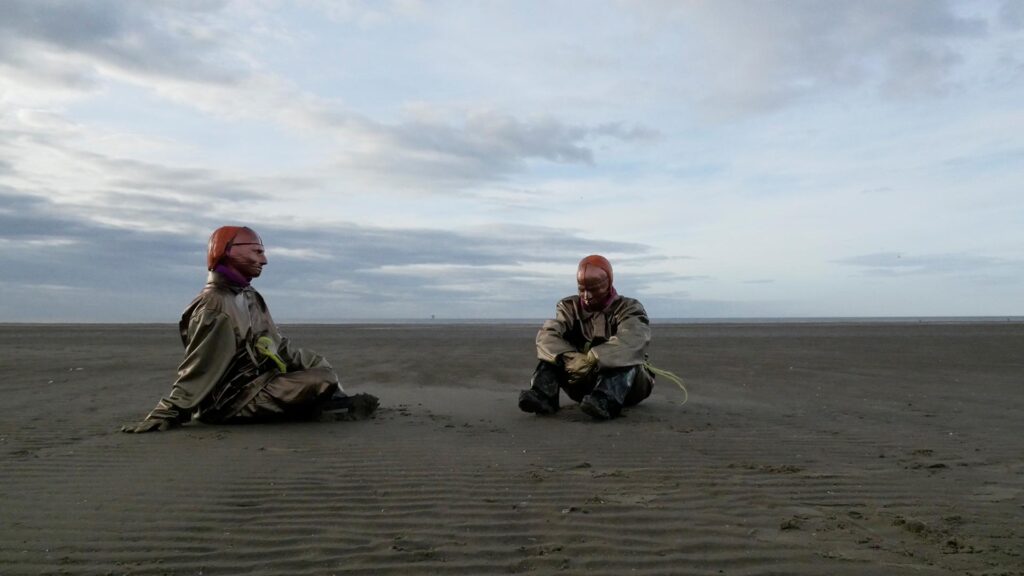
T(n)C (Agnes Varnai and Tina Kult)
Dreams Beyond the Grind, 2022–2025
Dreams Beyond the Grind imagines what happens when functionality begins to dream. Two robotic figures in golden work uniforms drift through fragmented visions: sitting at a dystopian shore, spinning endlessly on an office chair, dissolving into flickering images of rest and repetition. The work transforms mechanisms of labor into gestures of reverie. Through a dystopian lens, their work deals with structural and systemic problems of consumption, depletion and human desires, production relations and the misconception of laziness.
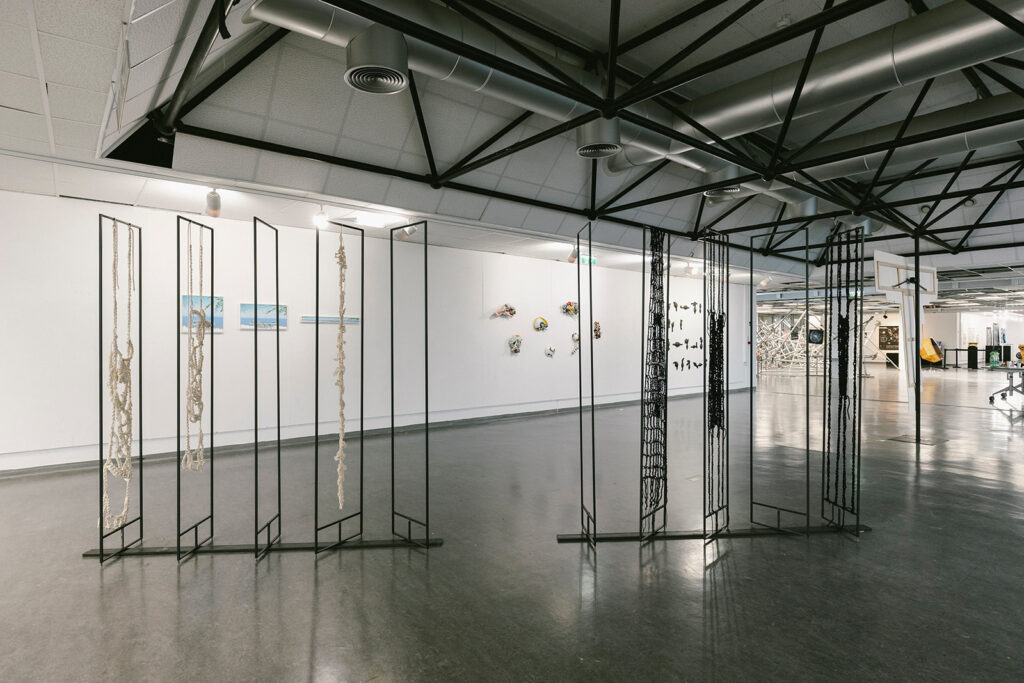
Nadine Lemke
No title, 2020
nadinelemke.net / @nadin_lemke
No Title consists of two linearly arranged metal structures, each carrying five slender, rotatable frames.
Within these frames unfold textile objects made of cotton, in deep black and soft natural white. The encounter of inorganic and organic, geometric and ornamental elements creates a dialogue in which opposites reveal their quiet beauty.
The frames are not merely supports, but windows that open interaction between the textile objects and the surrounding space. They invite viewers to perceive both the individual parts and the whole, and to reflect on the delicate balance between unity and division.
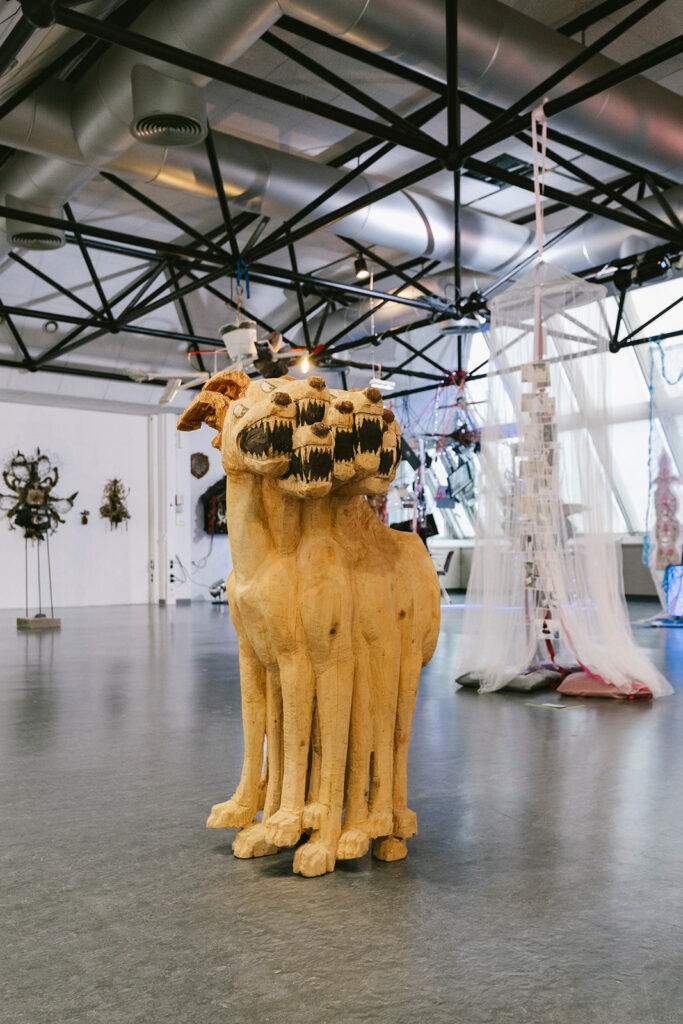
Martin Krammer
The Great Tremor, 2025
martinkrammer.at / @martinkrammer_art
What is self-evident in cartoons – movement, exaggeration, multiplication – becomes a sculptural strategy here. This sculpture attempts to make tremors visible: as simultaneity, as visual echo, as the permanent oscillation of a world in which much no longer seems certain. The multiplication represents the coexistence of contradictory voices, feelings, realities, and fantasies. For the noise, the roar, the unclear. And perhaps also for our present. A state of collective trembling is spreading. A time in which values such as democracy, truth, and peace are faltering, much faster than we could have imagined.
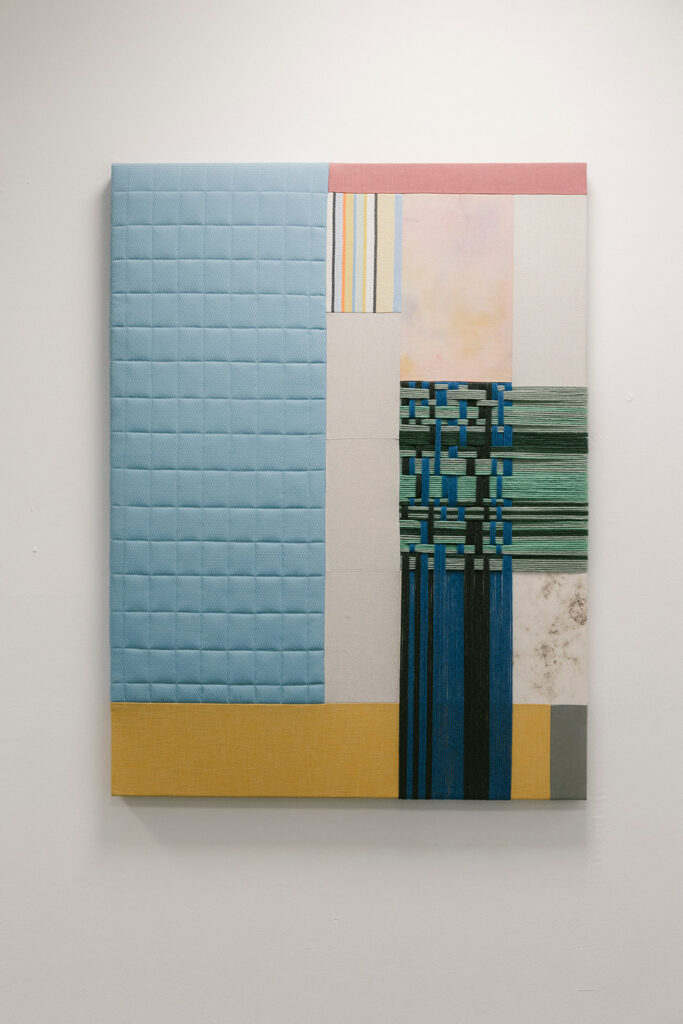
Meike Legler
The System, 2023
“The System”, a mixed media piece, is a literal depiction of how interwoven structures, processes and relationships in a system are.
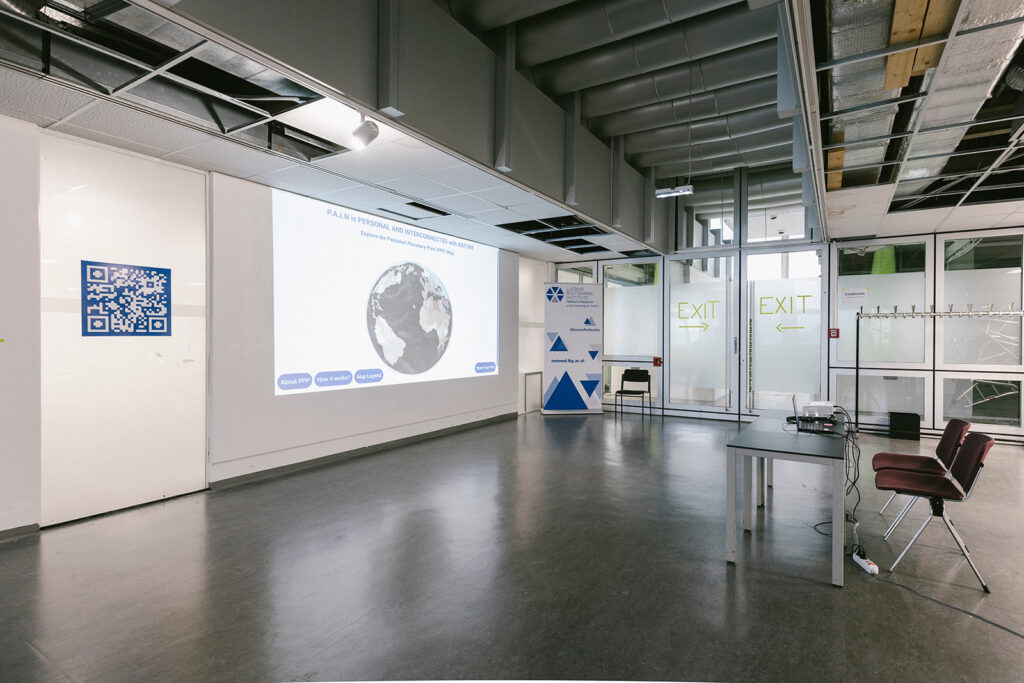
PAIN COLLECTIVE
Personal-Planetary-Pain (PPP) Map, 2025
https://p-a-i-n.world/ / @marymaggic / @dorasiafla / @hollis.hh
When the Earth is in pain, we are in pain. Presented at Ars Electronica 2025 in collaboration with the LBG Open Innovation in Science (OIS) Center and LBI-NetMed, the PPP (Personal–Planetary–Pain) project is an interactive map that explores the interconnectedness of ecological loss, socioeconomic suffering, and the human pain experience. Users are invited to share their own narratives of pain, which become part of a growing collective memory tied to sites of ecological distress around the world. By weaving together the personal and the planetary, the PPP map highlights both micro and macro crises, encouraging reflection on how ecological and health challenges leave lasting, interconnected imprints.
This project is part of the “Impact Initiative on AI, Art, and Health,” which explores new intersections of art, science, and healthcare. It was initiated by the LBG OIS Center and is carried out in cooperation with Ars Electronica and Johannes Kepler University Linz (LIFT_C, Institute for Transformative Change). The team consists of Dora Siafla, Hollis Hui, Julia Guthrie, Jack Heseltine, Ines Gerard-Ursin, Lukas Troyer, Mary Maggic, Mathieu Mahve-Beydokhti, Michael Artner, and Péter Velősy.
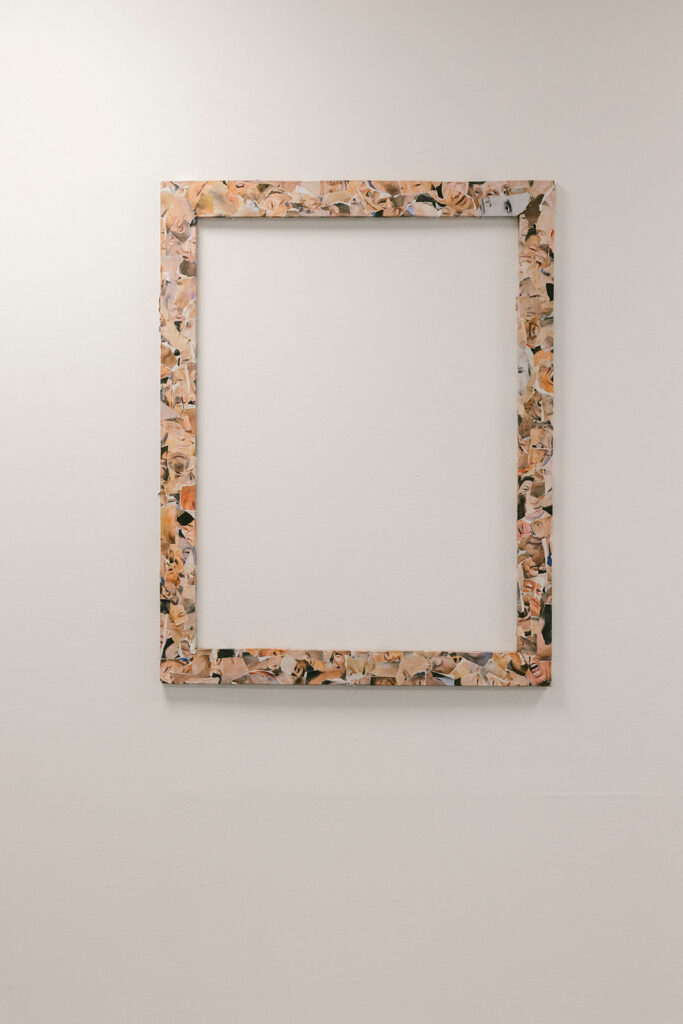
Oliver R. Meschnig
Victim, 2025
The artwork plays with the terminus of framing and its usage by modern-age oppressors and autocrates to legitimate their “defence”. They are only reacting, forced by external forces, by circumstances that never were alterable by them. They were always at someone else’s mercy. They always were victims.
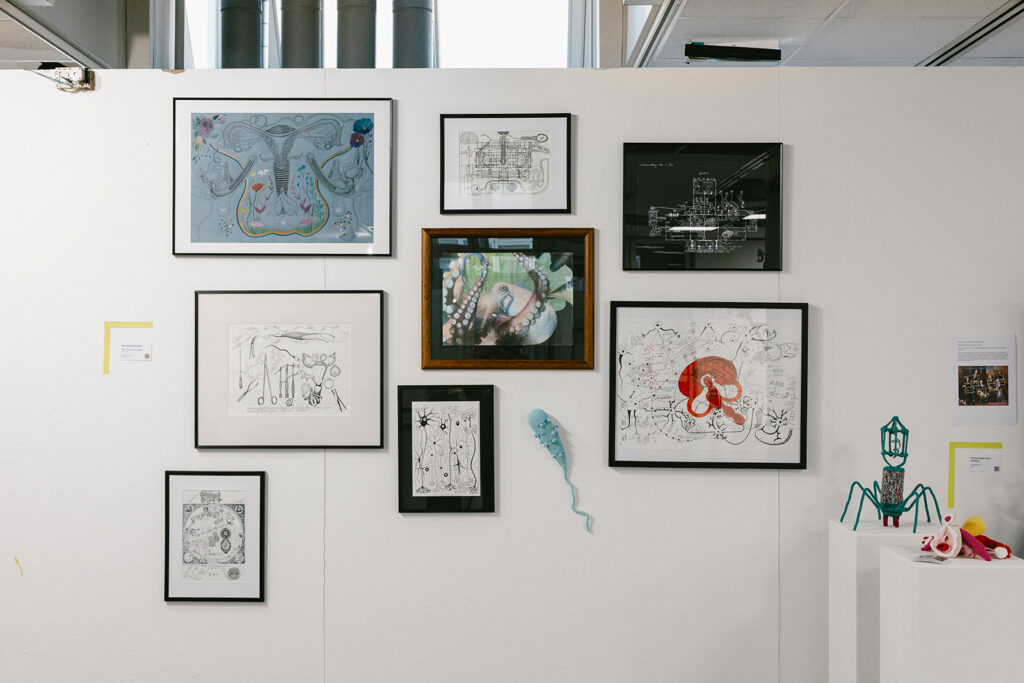
Rica Fuentes Martínez
Selected Drawings and Objects, 2016–2025
Rica Fuentes Martínez’s work spans drawing, watercolor, and crocheted objects, exploring the intersections of biology, history, and socio-political critique. She meticulously illustrates complex systems, from various types of neurons and human digestive tracts to the footprint of a beetle. A strong feminist lens critiques patriarchal structures; she addresses the marginalization of the female gender by referencing the healing power of the vulva (“Brust III”) and the history of genital mutilation (“Brust II”). Her drawings often merge anatomical or biological imagery with systemic critiques, such as depicting the parliament’s floor plan as male genitalia or linking the invention of the postal service to the origins of capitalism. Her crocheted objects bring microscopic life, like bacteriophages, and complex anatomy into tangible, sculptural forms.
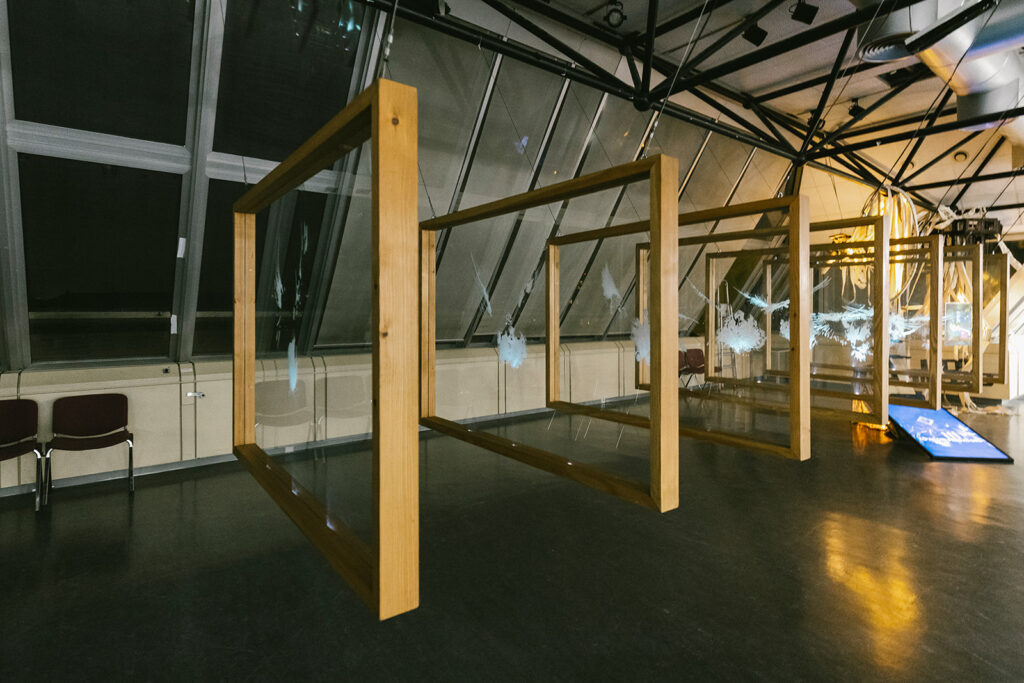
Peter Moosgaard
ANGEL (fine dust), 2024
@ o___gavvd___o / cargoclub.tumblr.com
Consisting of nine wooden frames, imprints of birds found on windows —delicate fine dust left on impact —have been permanently and forensically engraved in the glass. Arranged sequentially in space, the dust patterns create an imagined movement of flight, conjuring a liminal, almost tomographic being. By algorithmically illuminating the frames in rhythms of a human breath, the word “anima” as in animation is invoked in its deepest sense — as a breath, as soul.
Daniel Mazanik
Transistor, 2025
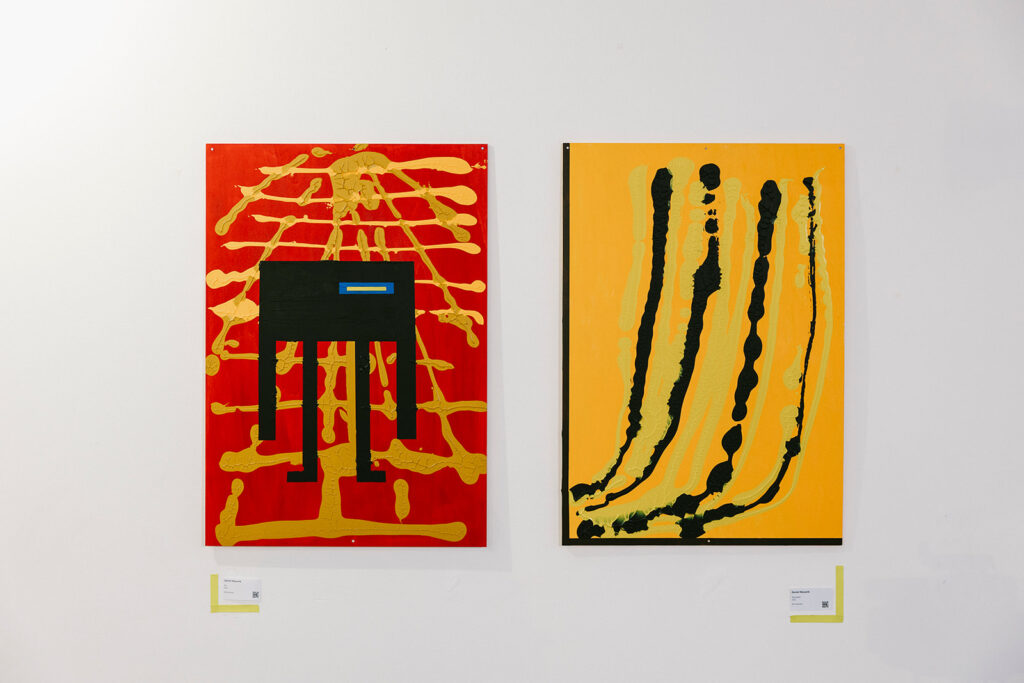
The transistor, as the fundamental building block of our modern world, has defined our daily lives since its invention. It creates the framework for new inventions and thus enables the influence of machines in our society. The transistor serves as the visual model for the works on display. The technique employed utilizes a specially developed stamping system.
freakygreenfish
GEN.E.SYS. [processing…], 2025
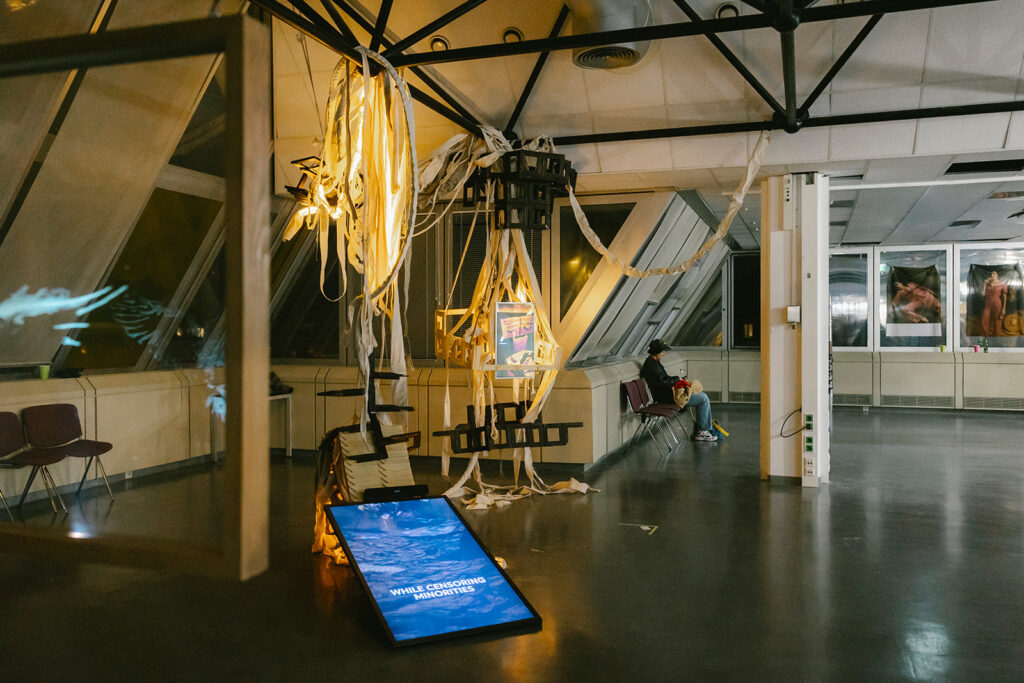
How can we strive for the future in a world that’s “spiritually Israel” while hanging in a constant state of ripping itself apart?
GEN.E.SYS., delulu about reality, theorises hyperstitional post-capitalist xenofeminist technical structures, which shall be implemented after we luigi accumulated power. This Gen. of users will post on their TikTok acc, but first they must be processed/born in this installation into the reality of platform capitalism.
Vanessa Mazanik
Cumulus IV , 2025
transmedialekunst.com/projekte/vanessa-mazanik / @vanessa.mazanik
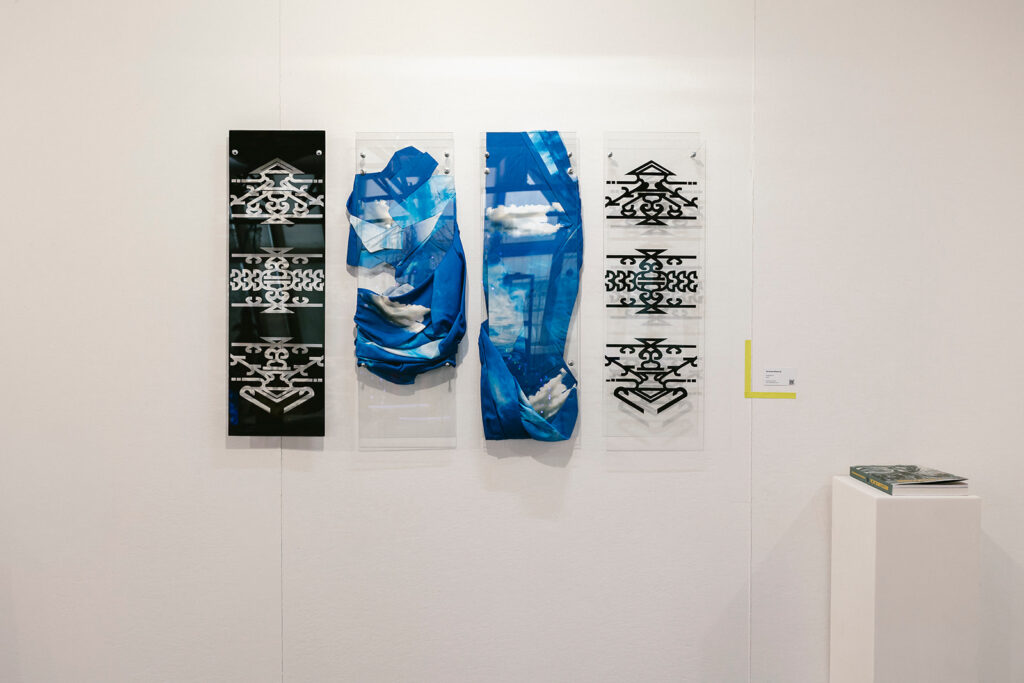
Glass is a material with an ambivalent function. It makes visible yet remains a liminal object. As the surface of digital devices, it is omnipresent, an interface between physical and digital space, on which images, information, and codes materialize only fleetingly. It is a medium for reflecting questions of perception, materiality, and mediality. Organic forms deliberately contrast with the clear, technical structures of the glass. The focus is particularly on clouds and the cloud symbols used in meteorology. A meteorological, symbolic, and digital element: the cloud. It represents storage, intangibility, atmosphere, and is part of a system, a circulation. In these works, it becomes an analogy of digital space: fleeting and intangible.
Sebastian Pfeifhofer
The Artworld after AI, 2025
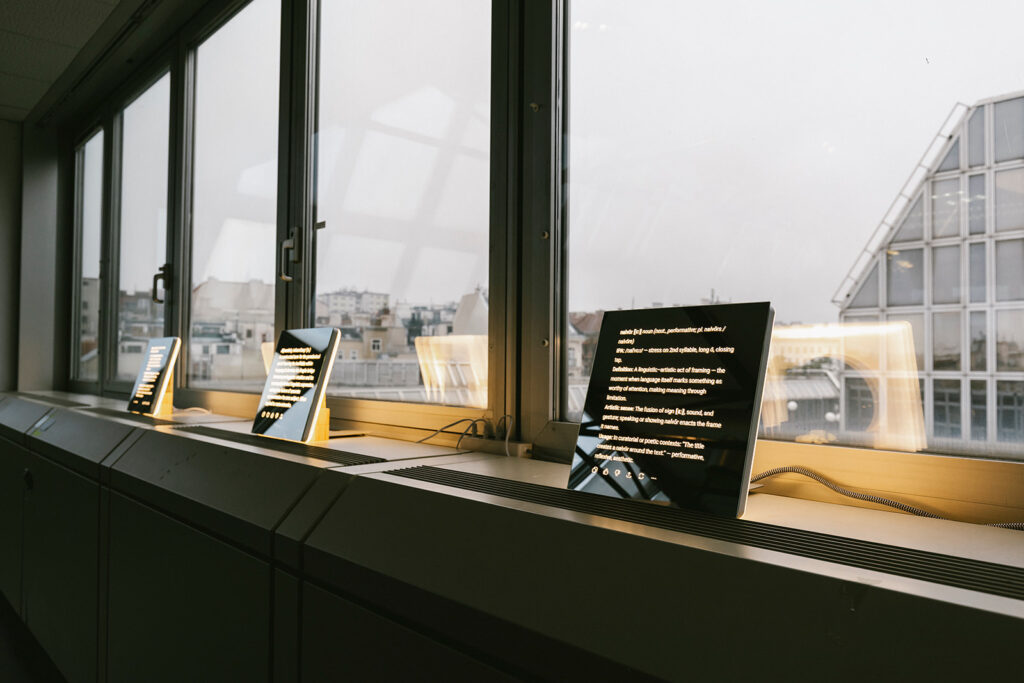
This work examines the framing function of language as well as the relationship between art, thought, technology, and reality. Various large language models are used to generate new words and to compose fictional dictionary entries for them. The title and concept reference key theoretical approaches by Joseph Kosuth and Arthur C. Danto.
Ernst Miesgang
CRITTERS (series)
ernstmiesgang.com / @ernstmiesgang / facebook.com/trens.sieggman
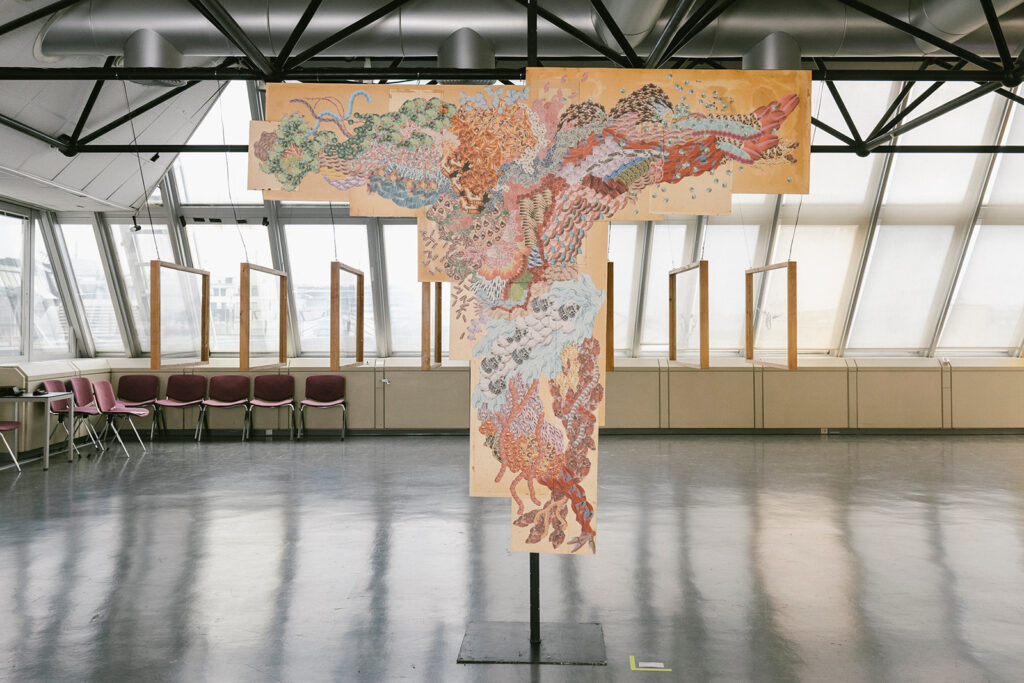
My large-format newsprint collages from the CRITTERS series appear like highly magnified microscope images of bacteria and viruses. I create them from free print media such as subway newspapers, which daily pollute urban spaces with populism, hate speech, and advertising. The largest collages are over three meters high and consist of thousands of scraps of paper.
Laurie Schram
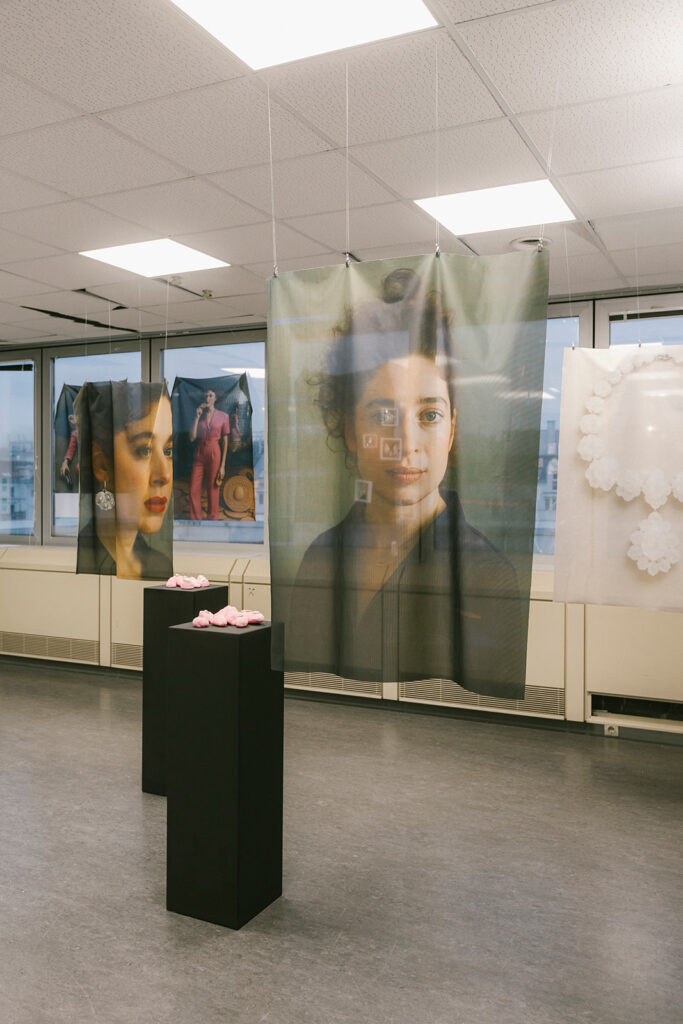
SCHRAM2.0, Identity Archive Is Not A Dog, 2025
SCHRAM2.0 is a fictional persona and art project developed by Dutch artist Laurie Schram. This alter ego embodies an alternative life path where artistic ambition and personal freedom take centre stage, unencumbered by caregiving responsibilities, professional and financial restraints. SCHRAM2.0 functions as a meta-artwork that explores the boundaries between reality and fiction, facilitated by collaboration with artificial intelligence. Through this digital partnership, a dialogue emerges about identity, autonomy, and the role of technology in art. AI attempts to have the persona create artworks as Schram herself would, resulting in a portfolio of subpar pieces stemming from a chatbot’s hallucinations, superficial clichés and derivatives of Schram’s work. SCHRAM2.0 is an approximation of a woman, an artist, who can no longer exist in reality.
Printed on delicate, translucent material, the image of the artist flickers between visibility and dissolution depending on light, angle, and framing. In one moment she seems to stand before the viewer; in the next, she fades into the background, merging with her surroundings. A series of artefacts appear with her: reverse-AI jewellery, coins, prosthetic fragments. These oscillate between material fact and fictional residue. They are created from the artist’s personal belongings and enter the alter ego’s world through mould-making and casting in fine silver, a small sculptural loop. Not generated by AI, but echoing its logic, they embody reconfiguration, fragmentation, and reassembly. These artefacts extend the project’s investigation into materiality and authorship, creating connections between the absent real and the visible persona.
Stella Mondin and Luca Ruzsics
Microbiom , 2025
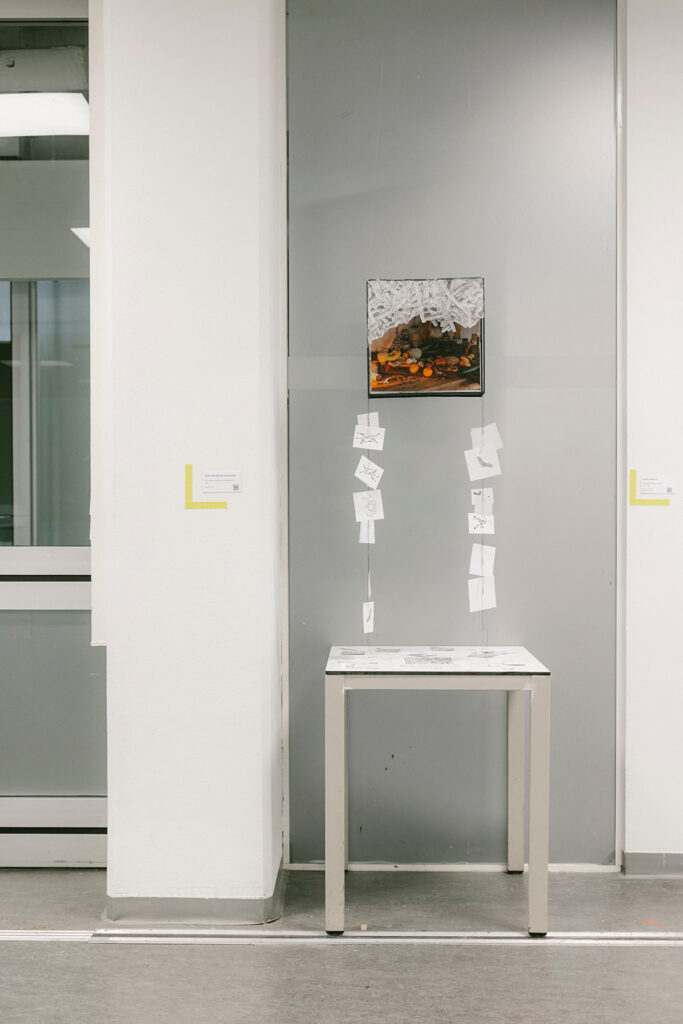
“Microbiom” is an interactive installation revealing the microbial ecosystems within the human body. Visitors engage directly with the art piece, experiencing these invisible networks in a tangible way.
Sarah Steiner
Vampy, 2024–2025
@sarahsteiner____ / sarah-steiner.com
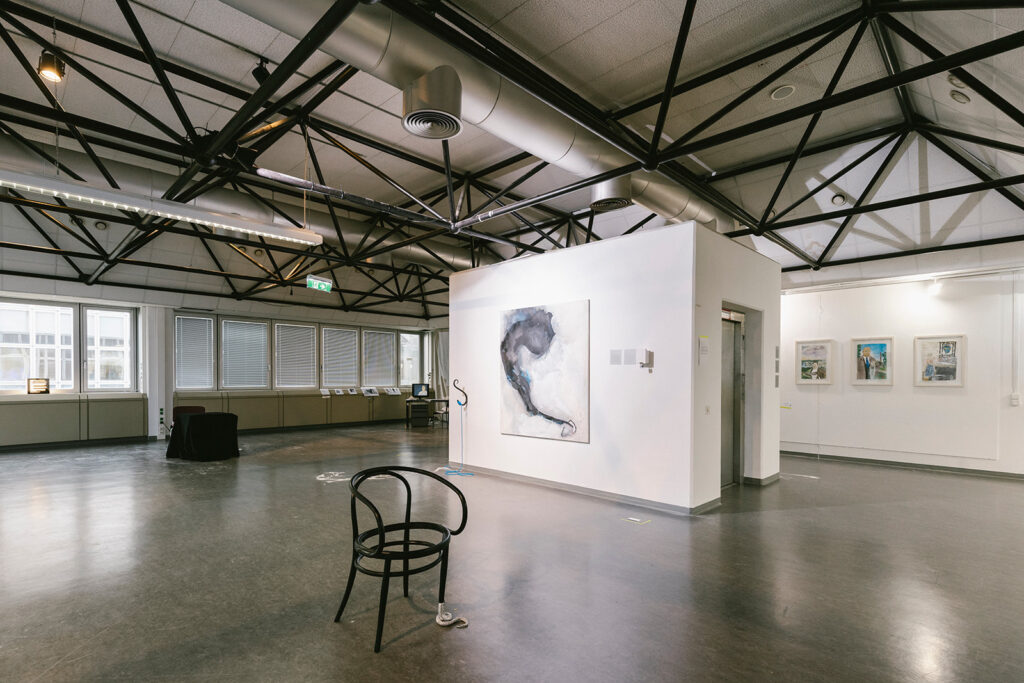
The title refers to Vilém Flusser’s novel Vampyrotheutis infernalis, in which he writes about the octopus – a creature of surreal and unsettling beauty. This deep-sea animal, with its writhing tentacles, becomes a metaphor for the unpredictable and the unfamiliar, urging us to think beyond human categories.
In Steiner’s autofictional installations paintings, objects, and texts interweave to form an open network that reflects on diverse modes of existence. Material processes of production serve as a starting point for the creation of fluid, often contradictory figures. The tentacle becomes a symbol of transgression and hybridity, as well as for new forms of generating knowledge and identity. Donna Haraway’s notion of “tentacular thinking” provides a model here: a way of thinking that is neither linear nor hierarchical, but networked, relational, and interdependent.
Through multimedia compositions, the artist explores the relationships between subject, material, and world – opening up a space where the indeterminate, the other, and the not-yet-imagined can emerge.
Oskerhase
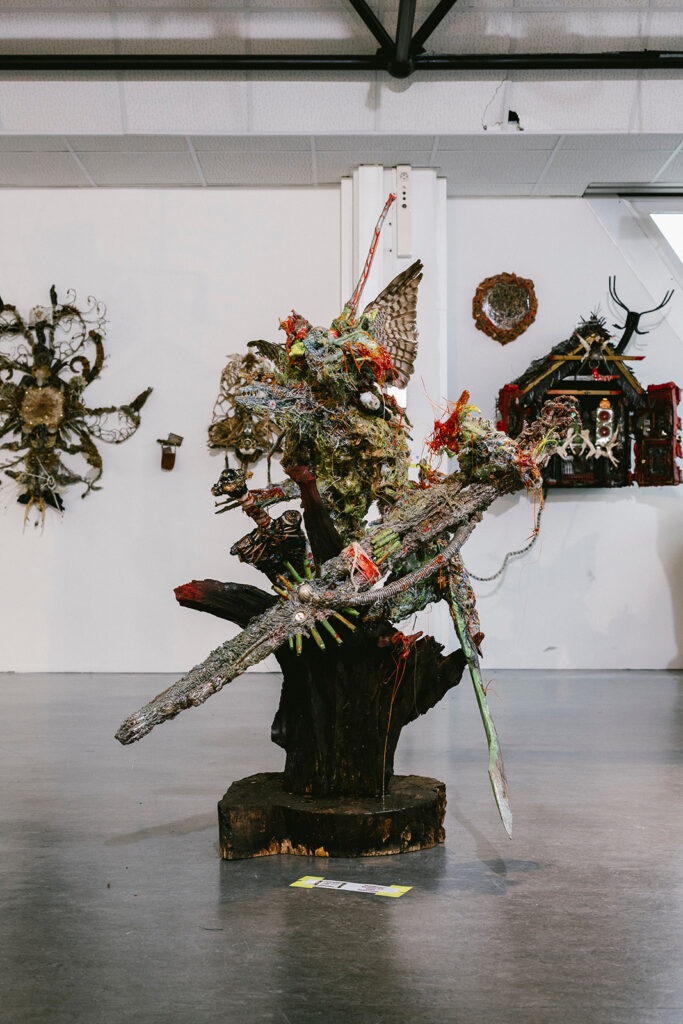
HETEROTOPIA POST APOCALYPTICA (Participation), 2025
As part of the “HETEROTOPIA POST APOCALYPTICA” exhibition, oskerhase’s work contributes to an exploration of doomsday scenarios and crises. The project speculates on the world after an apocalypse, questioning what perspective art can cast on the times before and after. It imagines a new world within the world—a place for affirming differences and a refuge from repression. This heterotopia is for experiences outside the familiar routine, where everything can be different, intense, and disturbing, opening a dialogue where utopias become possible. The work also taps into the themes of “SCARY MONSTERS and NICE SPRITES,” where fantasy, dreams, and the unreal become the new reality.
Melina Steiner
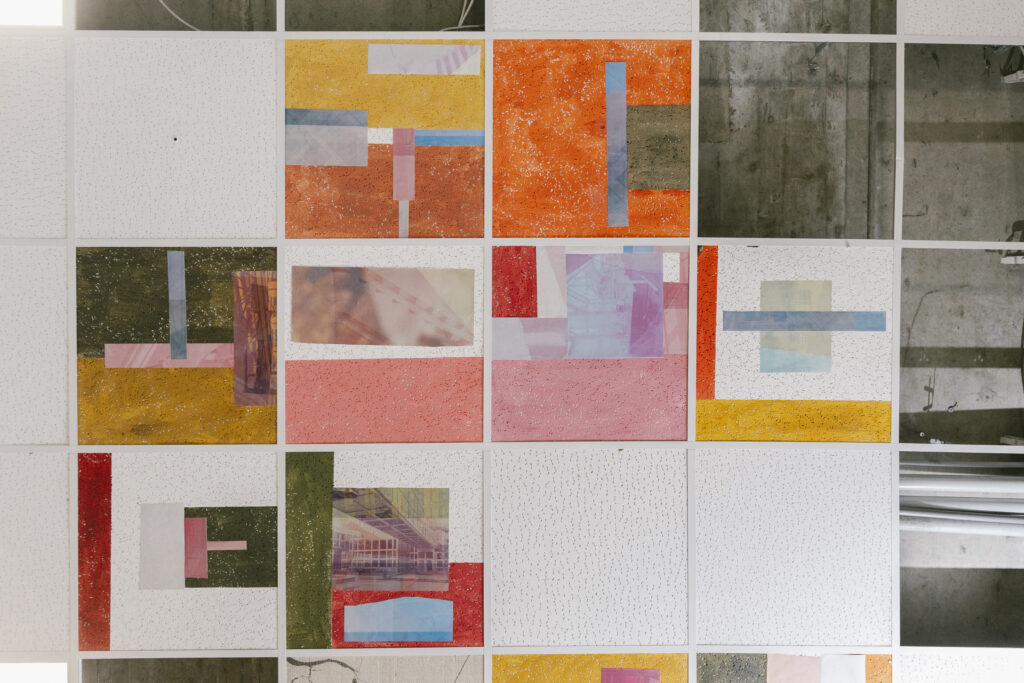
Ceiling Composition, 2025
This work is a homage to the library of the former University of Economics, a place with both personal and collective history. My mother worked here for nearly thirty years and I remember spending time in the building as a child. This exhibition marks the last one before the building closes.
I used ceiling panels identical to those found in the space and combined them with photographs from its past. Through painting and collage, I created new compositions that reconnect with the architecture while reflecting on memory and transformation.
By installing the panels on the ceiling, they return to their original place in a changed form. The work explores how spaces shape our perception and how personal experience, time, and material become connected. It reflects on how framing defines what becomes visible and how we relate to a space that is about to disappear.
Monika Pietrzak-Franger
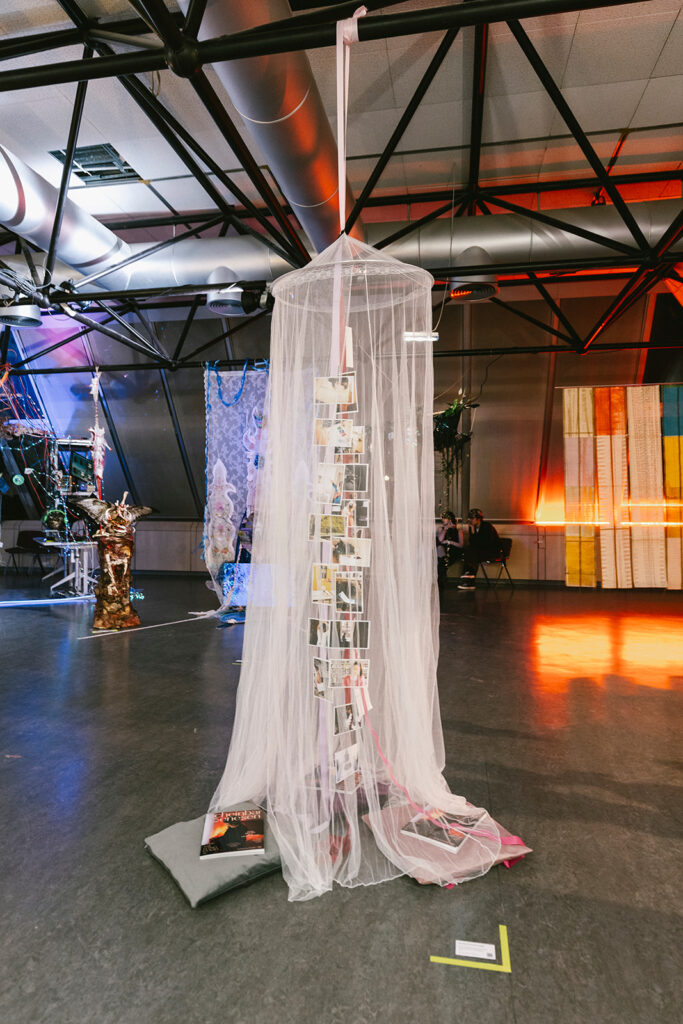
[Protected Space (Long Covid Book Installation)], 2025
anglistik.univie.ac.at/staff/staff/pietrzak-franger / medicalhumanities.univie.ac.at
The installation is planned as a roof or tent crafted from the protective covers (dust jackets) of a book about Long Covid. Underneath this structure, a protected space is created, dedicated to fostering greater understanding.
Daniela Trinkl
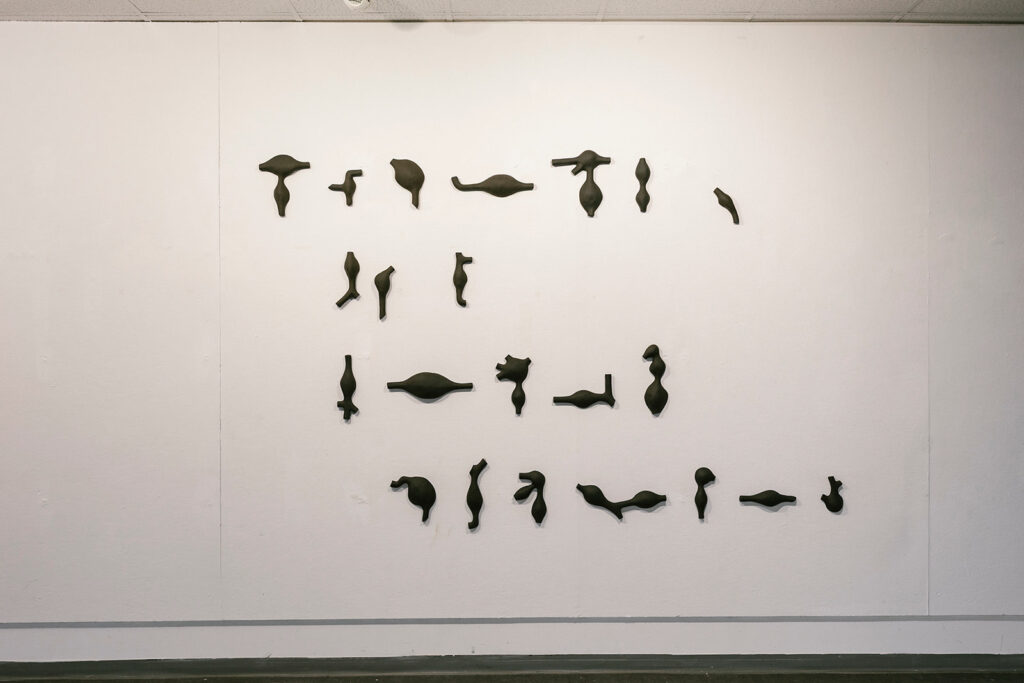
Fragments, 2019
@daniela.trinkl / danielatrinkl.com
In the series Fragments, individual objects stand side by side like characters from an unknown script. Each fragment resembles a letter or symbol that could be part of a larger code – a language at once familiar and indecipherable. They recall relics of a distant past, yet also hint at traces of a possible future. This oscillation between archaism and futurism, between transmission and projection, shapes the perception of the works.
Their forms shift between technical precision and organic presence. Some resemble grown structures, others appear constructed, as if born from an experimental fusion of nature, technology, and medicine. The power of the objects lies in this ambivalence: they resist clear categorisation and invite viewers to read them as a visual grammar pointing to a different understanding of the world.
Fragments are evidently parts of a larger whole, separated from one another. Through this very separation, a new framing emerges: arranged side by side, the individual elements form an alphabet that directs perception while raising questions of origin, meaning, and translation. As a language of fragments, they reveal how every framing selects, excludes, and opens alternative spaces of knowledge where memory, science, imagination, and corporeality are interwoven.
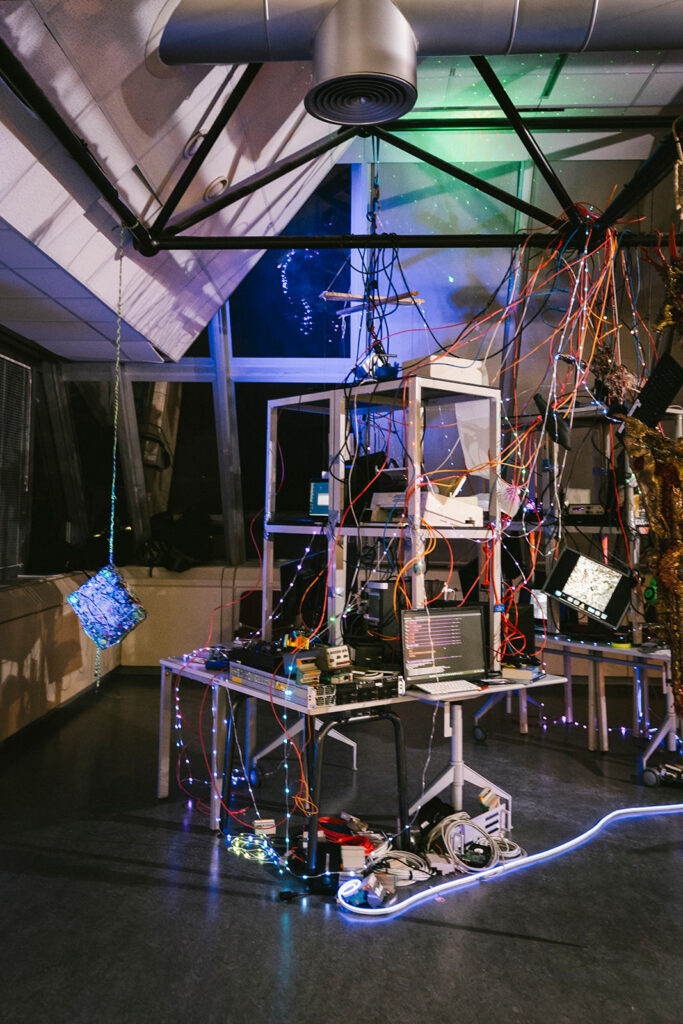
Sebastian Pirch, Norbert Unfug, and Annette Tesarek
The PILE OF TRASH X SPACE ORACLE, 2024/2025 (iteration, base project earlier)
a-tesarek.com / @tesarekannette / @norbertunfug / echtzeitkunstwelt.net
The PILE OF TRASH is a media installation by Sebastian Pirch and Norbert Unfug, embodying artificial intelligence. Constructed from obsolete machinery, it uses AI to perceive its surroundings via sound and visuals, integrating film excerpts and live imagery, commenting on technology, waste, and the digital sphere. The PILE OF TRASH X SPACE ORACLE iteration builds upon this concept through a real-life performance by Annette Tesarek. Tesarek interacts live with the AI (using local voice detection, Stable Diffusion XL image generation, and ChatGPT API for Oracle answers), creating a dynamic engagement. This fusion of physical computing waste and live AI interaction explores the evolving human-AI relationship in a performative context, raising questions about authorship, originality, and ownership in art and science.
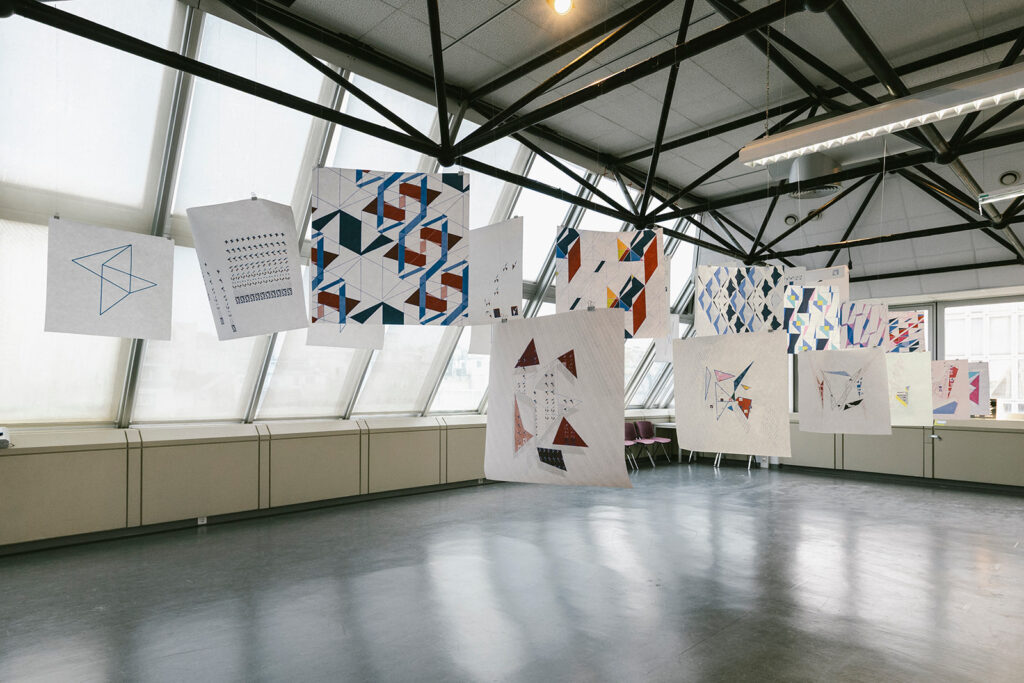
Sarah Wilhelmy
words without words , 2024–present (ongoing)
Some meanings are social; they are made for shared action, information, culture and law. These meanings need words in order to exist beyond abstraction. We see these words everyday: across media, through public relations, vestigial journalism, over dinner, over a glass of wine, what we whisper to our souls at night*.
If any words- particularly about the sanctity of human life- still had meaning, we would stop the world with no hesitation. But this is a brutal time, in which words perform only the most transparent mockery of themselves. They are empty containers; their meaning is everywhere but inside.
This is not a new or sudden process. And yet.
Each row of prints is an encoded story: from Word to (Un)Meaning, from Historical Precedent to Now. Visitors are not expected to walk through every word, but be peripherally aware of systemic repetition. The concluding prints are being covered by drawings of their respective double-meaning pattern. The time spent drawing is recorded and spent again on less metaphorical efforts.
A long work: repetitive, normalized.
It is simply a refusal of motionlessness.
*The colors used are simple combinations of CMYK, pencil and pen inks for office or at-home use.
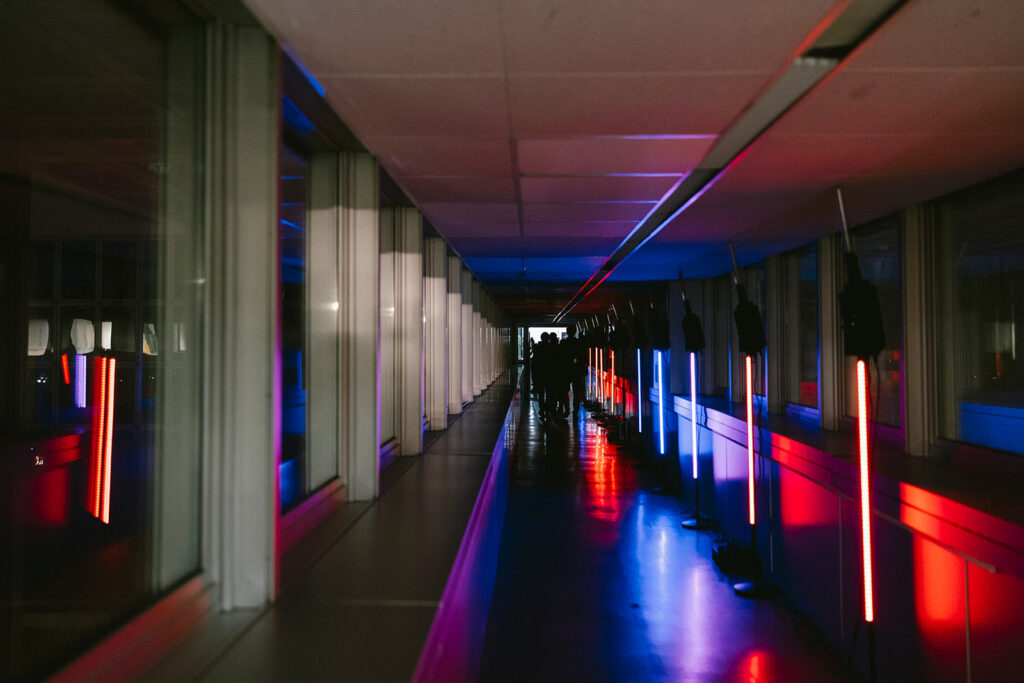
Chris Schratt
Light Installation, 2025
Chris Schratt utilizes light as his primary medium for this installation. While specific details for this 2025 work are not provided, his practice generally engages with the properties of light, exploring themes of perception, space, and the interplay between illumination and environment.
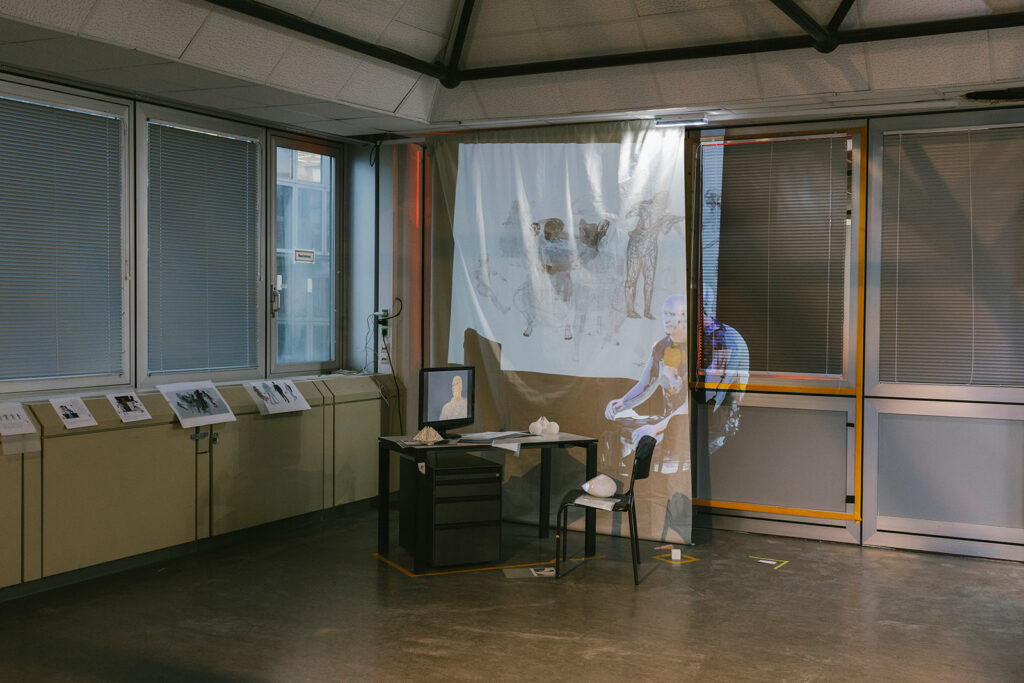
Aga Zagraba
The Land of Bearing Shapes, 2024
agazagraba.com / @bearing_shapes
Each of us possesses a specific shape stored in „The Land of Bearing Shapes”. A Bearing Shape is a unique spatial structure that expresses the essence of every individual. It has a dualistic nature — it is being borne, but it also bears. The „Land of Bearing Shapes” aims to explore how emotions, energy, and life itself can be metaphorically expressed in the technical language of CGI 3D graphics. The narrative is based on the mismatch between the complexity of the real world and the limited capacities of 3D software..
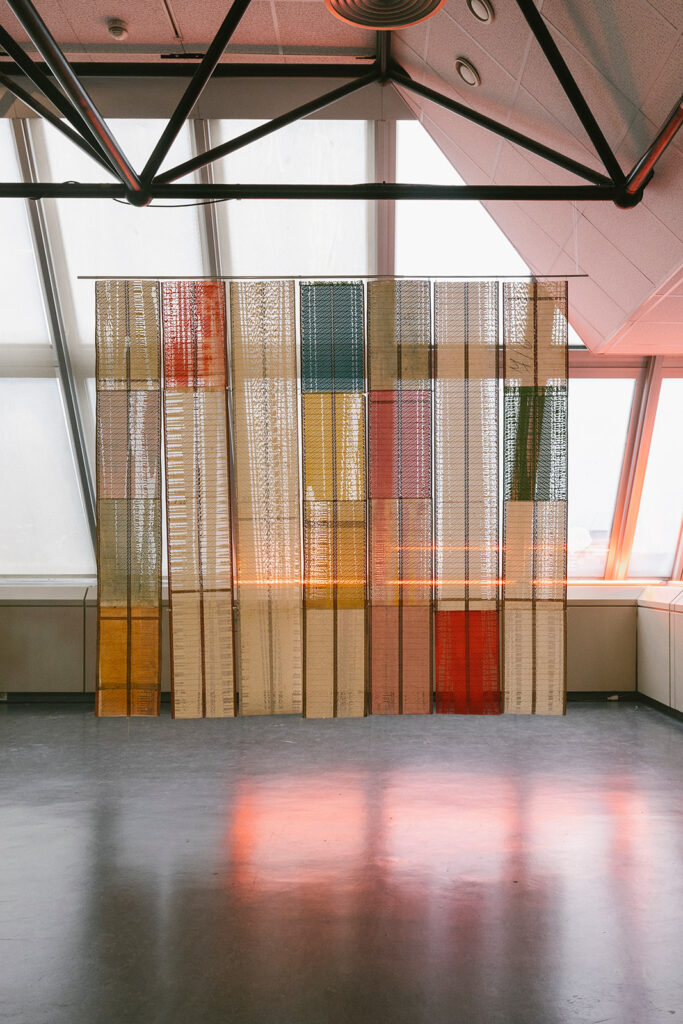
Bettina Schülke
Punchcard Installation, 2025
Bettina Schülke works at the interface of art, science, and artistic research. Her Punchcard Installations cycle focuses on investigating the connections between textiles, punch cards, binary code, and our current technologies. With a background in art and textiles, these works combine current thematic questions with an aesthetic, spatially specific implementation outside of an ordered, predefined framework.
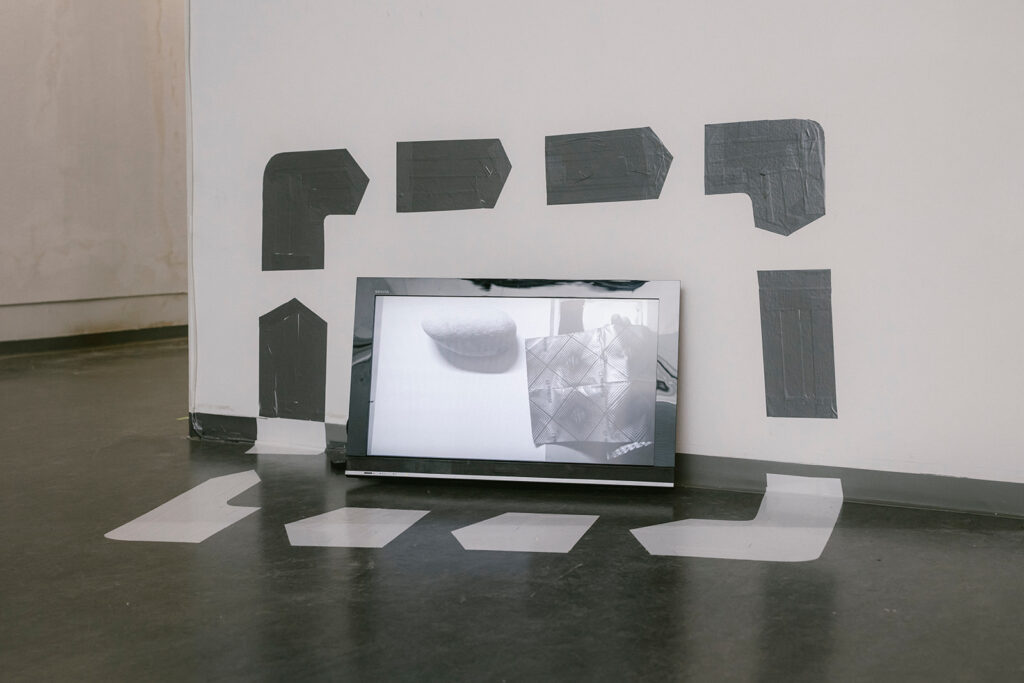
Q_plus_I
2 + 8: a response, 2025
@q_plus_i / google.com/view/q-i
Q_plus_I present a collaborative video installation with the Q_plus_I Collective (videos from artists: Liz Melchor, Bryan Parsons, Ziegi Boss, Sally Senton, Pragya Bhargava, Jenny Baines, Maria Glyka, Natalia Charogianni) that transforms framing into both method and subject. Ten artists created short videos in response to drawing prompts given by Q_plus_I—for example, make an abstract drawing in response to music. Each artist’s video, no longer than 30 seconds, documents the act of making a drawing (limit 2 minutes). Importantly, each video also begins in response to the previous artist’s contribution, forming a continuous chain of influence.
This evolving sequence establishes a framework for learning through framing: each artist works within the boundary of their prompt, while also negotiating the approach of the artist before them. The installation, presented across two monitors in dialogue, emphasises the directional flow of this process—guiding viewers from one frame to the next and revealing how knowledge circulates through a system of exchange.
By working within a chain of prompts and responses, this highlights how each contribution is shaped by a frame—whether the literal border of the video, the instruction given by Q_plus_I, or the sequential structure linking one artist to the next. These frames act as both constraints and possibilities: they limit what can be done while also generating unexpected directions and new forms of collective learning.
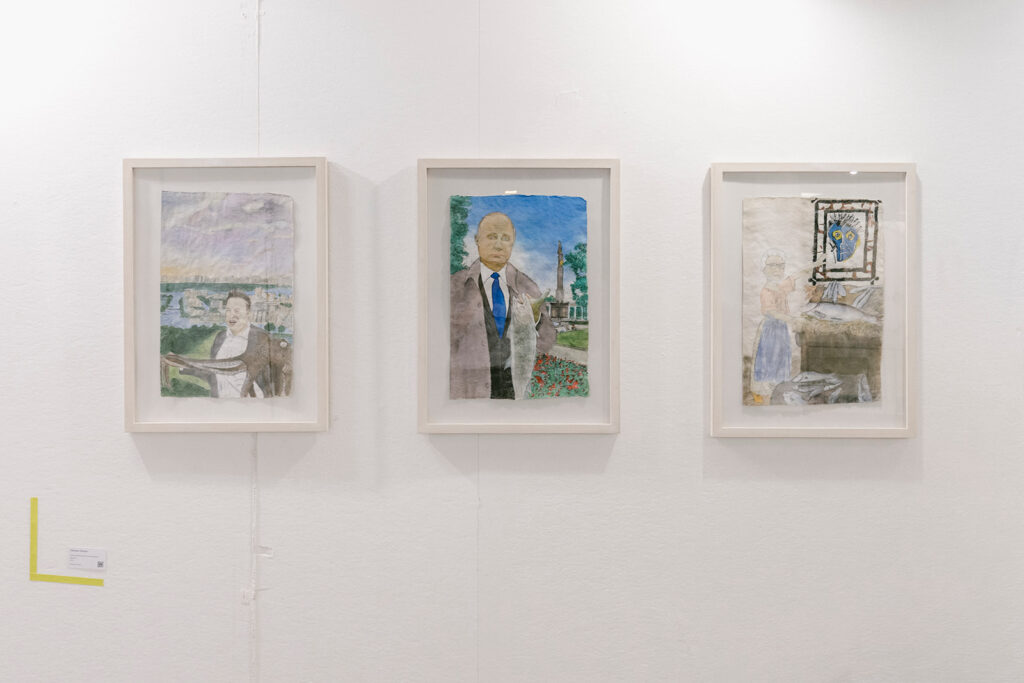
Clemens Stecher
[Series exploring prey presentation behavior], Ongoing/Current
Clemens Stecher lives and works in Vienna, exhibiting and performing in galleries, institutions, and museums across Europe and China. These works are part of a series that explores, on the one hand, the male behavior of presenting prey and, on the other, the political aspects of this behavior.
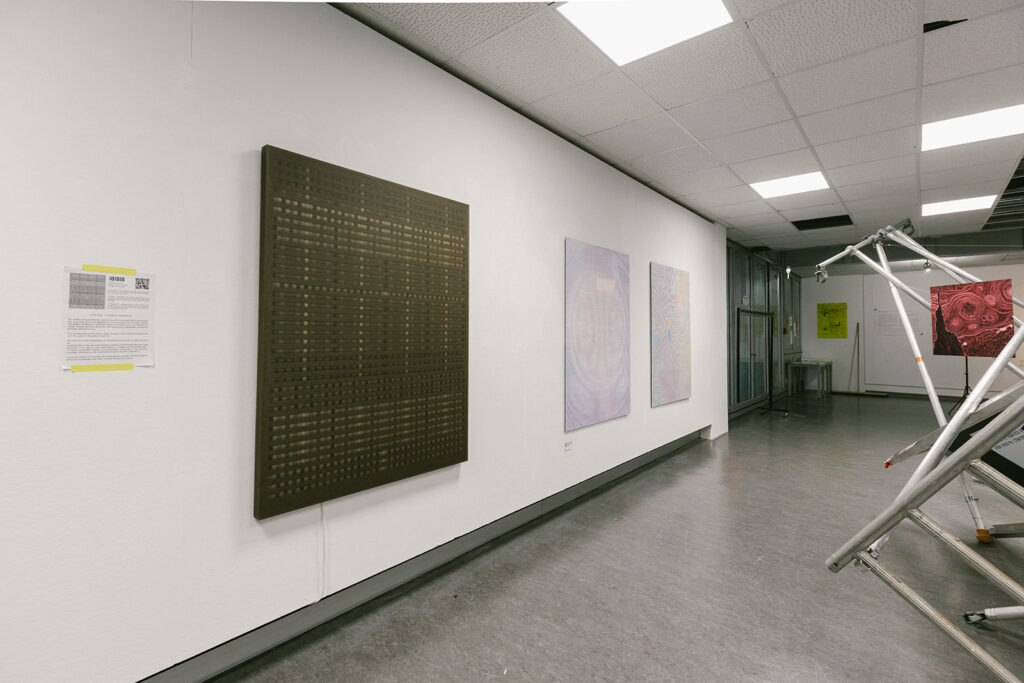
STUDIO 101010 (Eric Lorenz and Paraskevi Frasiola)
D1Q6 Potts – Competing Interpretations
Interference #12
Interference #9
studio101010.com / @Studio.101010
Studio 101010’s kinetic artworks blend scientific simulation with
artistic expression, displaying dynamically evolving patterns in a
controlled shift between chaos and coherence. The works invite
contemplation of entropy and order and their underlying mechanisms,
and offer intuitive insights into the complex systems that surround
us.
Interferences is a series of works by Paraskevi Frasiola that
investigates how technology, science, and traditional art practices
inform each other in evolving visual languages. Digital artefacts
from online sharing are embraced as creative tools and metaphors for
shifting meaning and interpretation.
The Meaningful Noise Collective
Penametron v1, 2025
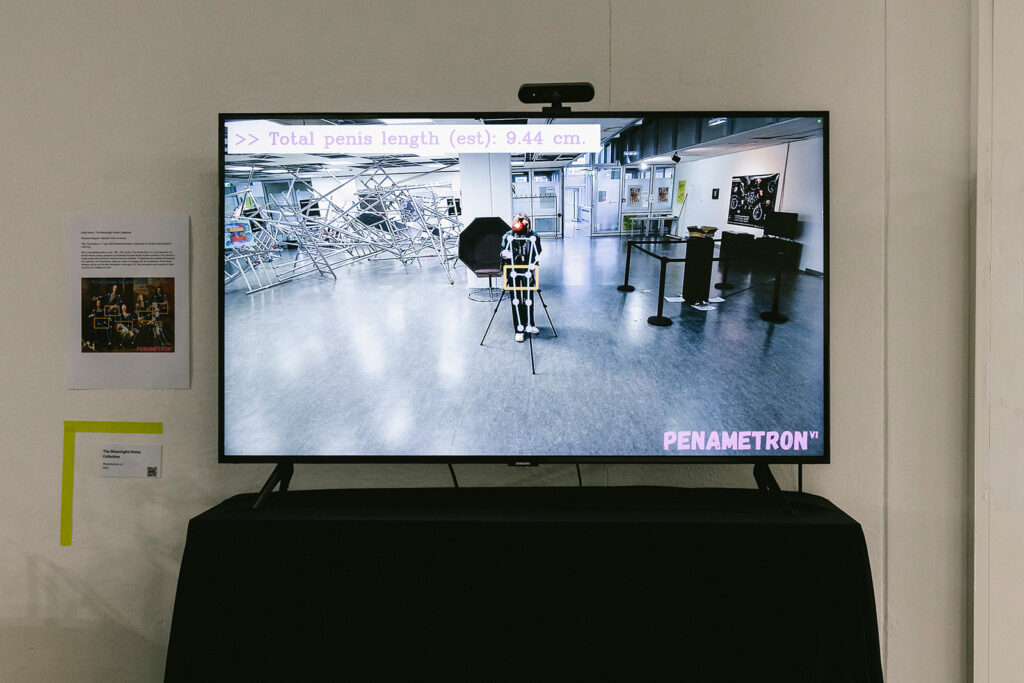
The Penametron v1 is an interactive art exhibit whose primary purpose is to estimate the total length of penis present in the camera’s image using state-of-the-art machine learning methods. In obtaining and publicly showcasing this estimate, the Penametron asks the viewer to engage with the breakdown of the divide between public and private information in the age of AI, the provenance and veracity of data on which the models are built.
Oleg Ustinov
The eye (Crucified I), 2024
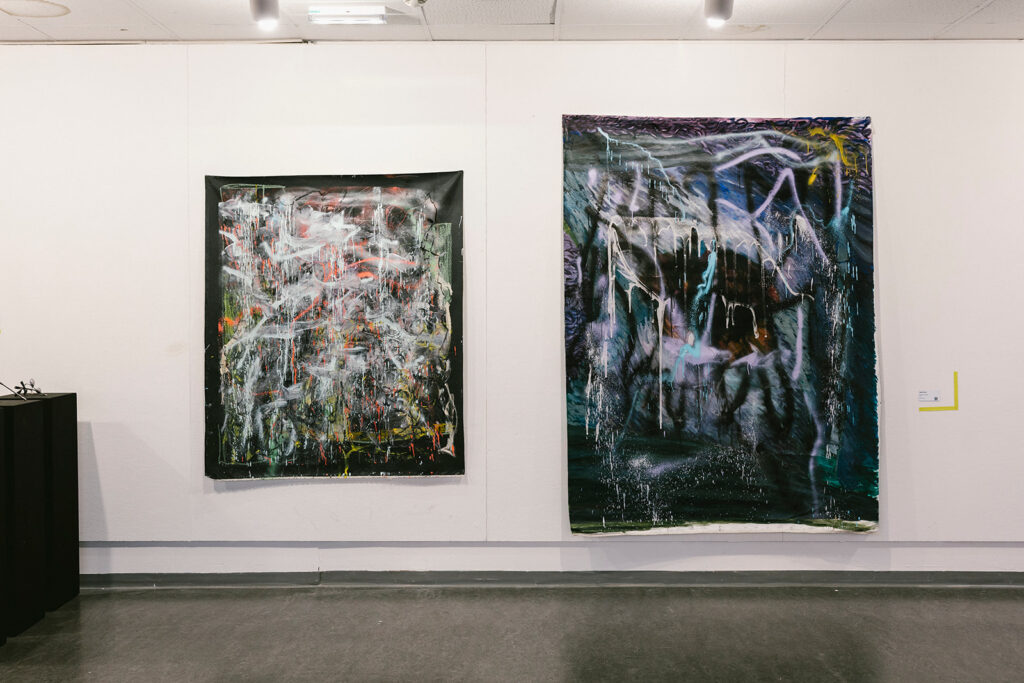
This new work continues Oleg Ustinov’s experiments in abstract painting. The background has turned black, found materials have been added, and new experiments with dripping have appeared. This time, the artist stopped resisting signification and titled the work as viewers saw it — Crucified I, while also being known as “The eye”.
Ana Vollwesen
Giorgio, 2025
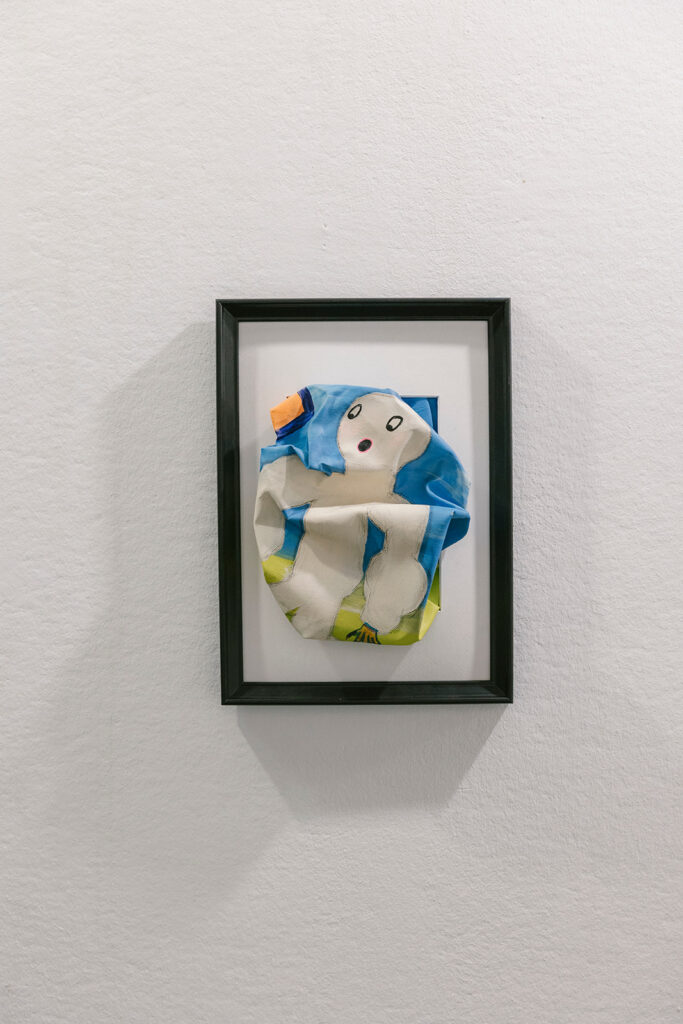
Ana Vollwesen is a multidisciplinary artist from Vienna. Her work, “Giorgio,” explores the notion of breaking away from the norm, being out of the box, reflection, and emotion. Being more human.
Begi Guggenheim + Daniel Mazanik
The Magic of Levitation, analogue floating sculpture, 2025
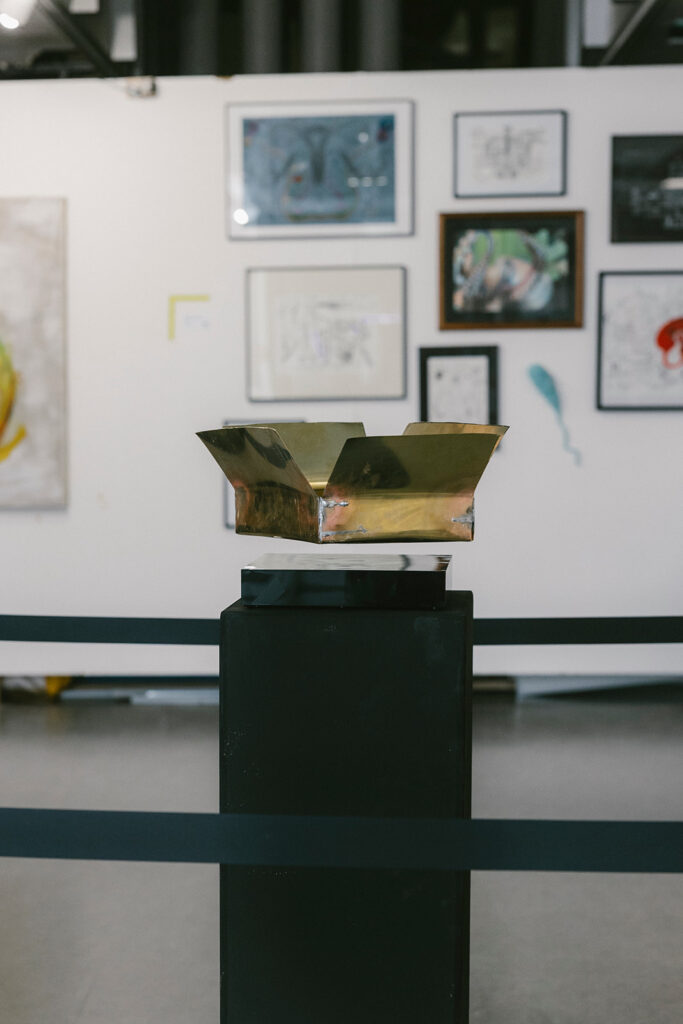
Daniel Mazanik and Begi Guggenheim come from space research and sculpture. As a result of the interaction of these areas, they make a sculpture float. It is an attempt to abolish the old logic of the medium of sculpture as a static and representative image and to reconcile the magic of levitation with physical precision.
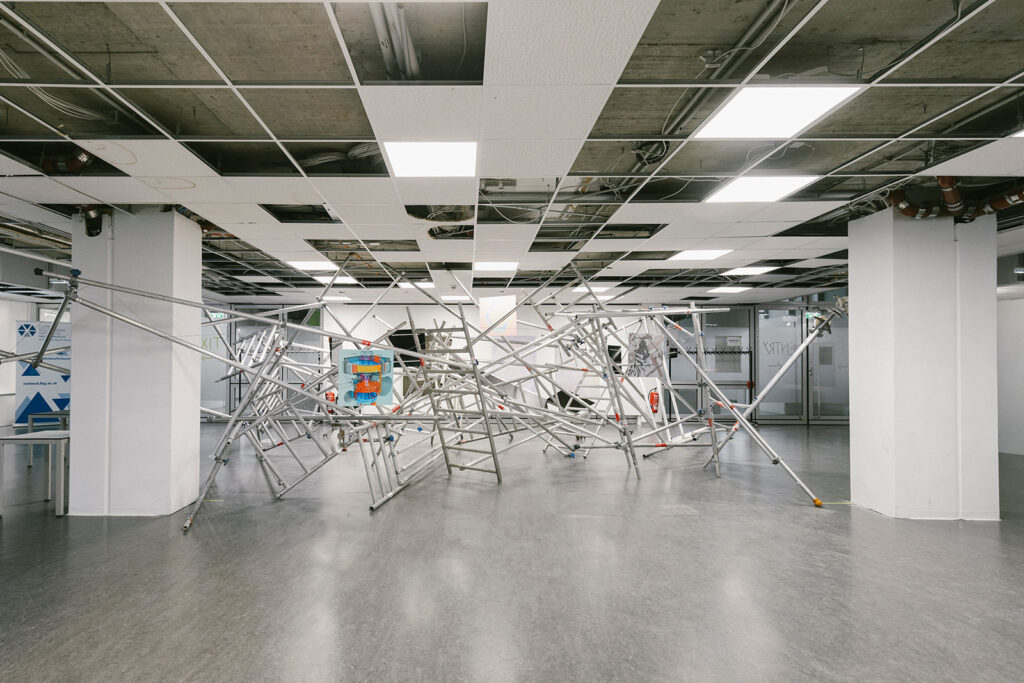
LBI-NetMed
Scales across Frames, 2025
https://art.lbi-netmed.com/ | netmed.lbg.ac.at/
Biology unfolds across a wide range of scales — from the nanometer choreography within molecules to the billion fold larger meter-long anatomy of organisms. Each level reveals its own logic and beauty, yet all are connected, forming a continuous web of life.
Within the scaffold, a series of suspended frames depict biology across orders of magnitude. Each 「Frame」opens a window into a different scale of research — from molecular to cellular, from tissues to organisms— mirroring the institute’s exploration of life across dimensions.
Together, the scaffold and frames create a tangible journey through what we know, and what we have yet to uncover, celebrating both the structure and the mystery of living systems.